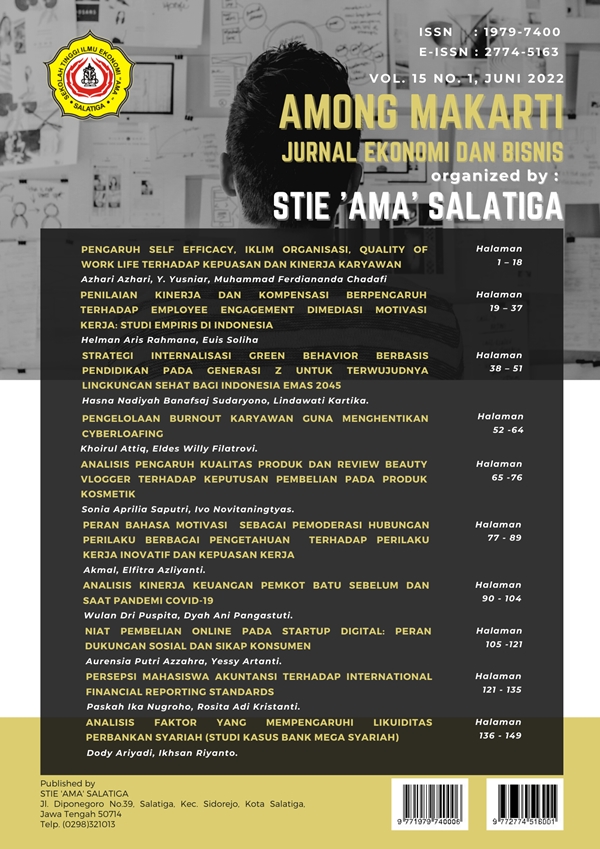
PERAN BAHASA MOTIVASI SEBAGAI PEMODERASI HUBUNGAN PERILAKU BERBAGAI PENGETAHUAN TERHADAP PERILAKU KERJA INOVATIF DAN KEPUASAN KERJA
DOI:
https://doi.org/10.52353/ama.v15i1.245Keywords:
Knowledge sharing behavior, innovative work behavior, job satisfaction, motivational language.Abstract
The purpose of this research is to explore the effect of knowledge sharing behavior on innovative work behavior and job satisfaction among employees using motivational language as a moderating variable. Hypothetical relationships were tested using STATA analysis. Data were collected using a questionnaire with a total of 45 employees in the company. The results of the study found that the behavior of sharing knowledge had a positive effect on innovative work behavior, while the behavior of sharing knowledge had a negative effect on employee job satisfaction. Furthermore, motivational language moderates the relationship between knowledge sharing behavior and innovative work behavior
References
Afsar, B. (2016), “The impact of person-organization fit on innovative work behavior: the mediatingeffect of knowledge sharing behavior”, International Journal of Health Care Quality Assurance,Vol. 29 No. 2, pp. 104-122.
Aichhorn, N. and Puck, J. (2017), “‘I just don’t feel comfortable speaking English”: foreign languageanxiety as a catalyst for spoken-language barriers in MNCs”, International Business Review,Vol. 26 No. 4, pp. 749-763.
Akhavan, P., Rahimi, A. and Mehralian, G. (2013), “Developing a model for knowledge sharing inresearch centers”, VINE, Vol. 43 No. 3, pp. 357-393.
Akhavan, P., Hosseini, S.M., Abbasi, M. and Manteghi, M. (2015), “Knowledge-sharing determinants,behaviors, and innovative work behaviors: an integrated theoretical view and empiricalexamination”, Aslib Journal of Information Management, Vol. 67 No. 5, pp. 562-591.
AlShamsi, O. and Ajmal, M. (2018), “Critical factors for knowledge sharing in technology-intensiveorganizations: evidence from UAE service sector”, Journal of Knowledge Management, Vol. 22No. 2.
Amjed, A. and Tirmzi, S.H.S. (2016), “Effect of humor on employee creativity with moderating role oftransformational leadership behavior”, Journal of Economics, Business and Management, Vol. 4No. 10, pp. 594-598.
Bandura, A. and Walters, R.H. (1977), Social Learning Theory, Vol. 1, Prentice hall, EnglewoodCliffs, NJ.
Bandura, A. (1977), “Self-efficacy: toward a unifying theory of behavioral change”, PsychologicalReview, Vol. 84 No. 2, pp. 191-215.
Bandura, A. (1978), “The self-system in reciprocal determinism”, American Psychologist, Vol. 33 No. 4,p. 344.
Bandura, A. (1997), Self-Efficacy: The Exercise of Control, Macmillan.
Berry, H. (2017), “Managing valuable knowledge in weak IP protection countries”, Journal ofInternational Business Studies, Vol. 48 No. 7, pp. 787-807.
Cheng, C.-Y. and Tan, Y.W. (2017), “Intercultural experience and creativity”, The InternationalEncyclopedia of Intercultural Communication, pp. 1-12.
Chowhan, J., Pries, F. and Mann, S. (2017), “Persistent innovation and the role of human resourcemanagement practices, work organization, and strategy”, Journal of Management andOrganization, Vol. 23 No. 3, pp. 456-471.
Cummings, J.N. (2004), “Work groups, structural diversity, and knowledge sharing in a globalorganization”, Management Science, Vol. 50 No. 3, pp. 352-364.
Dalati, S. and Alchach, H. (2018), “The effect of leader trust and knowledge sharing on staff satisfactionat work: investigation of universities in Syria”, Business, Management and Education, Vol. 16No. 0, pp. 190-205.
Danish, R., Khan, M., Nawaz, M., Munir, Y. and Nisar, S. (2014), “Impact of knowledge sharing andtransformational leadership on organizational learning in service sector of Pakistan”, Journal ofQuality and Technology Management, Vol. 10 No. 1, pp. 59-67.
Farr, L.L. (2016), Motivating Language and Intent to Stay: An Investigation into the Mediating Effect ofJob Satisfaction in a Backsourced Information Technology Environment, Capella University.
Gutierrez-Wirsching, S., Mayfield, J., Mayfield, M. and Wang, W. (2015), “Motivating language as amediator between servant leadership and employee outcomes”, Management Research Review,Vol. 38 No. 12, pp. 1234-1250.
Hameed, Z., Khan, I.U., Sheikh, Z., Islam, T., Rasheed, M.I. and Naeem, R.M. (2019), “Organizationaljustice and knowledge sharing behavior: the role of psychological ownership and perceivedorganizational support”, Personnel Review, Vol. 48 No. 3, pp. 748-773.
Holub, S. (2003), “Knowledge sharing is a change-management exercise”, Tax Practice Management,Vol. 34 No. 6, pp. 361-363.
Hussain, K., Konar, R. and Ali, F. (2016), “Measuring service innovation performance through teamculture and knowledge sharing behaviour in hotel services: a PLS approach”, Procedia – Socialand Behavioral Sciences, Vol. 224, pp. 35-43.
Javed, B., Bashir, S., Rawwas, M.Y. and Arjoon, S. (2017), “Islamic work ethic, innovative workbehaviour, and adaptive performance: the mediating mechanism and an interacting effect”,Current Issues in Tourism, Vol. 20 No. 6, pp. 647-663.
Kang, M. and Lee, M.-J. (2017), “Absorptive capacity, knowledge sharing, and innovative behaviour ofR&D employees”, Technology Analysis and Strategic Management, Vol. 29 No. 2, pp. 219-232.
Kassem, R., Ajmal, M., Gunasekaran, A. and Helo, P. (2018), “Assessing the impact of organizationalculture on achieving business excellence with a moderating role of ICT: an SEM approach”,Benchmarking: An International Journal, Vol. 26 No. 1.
Kianto, A., Vanhala, M. and Heilmann, P. (2016), “The impact of knowledge management on jobsatisfaction”, Journal of Knowledge Management, Vol. 20 No. 4, pp. 621-636.
Li, X., Wang, J. and Liu, X. (2013), “Can locally-recruited R&D personnel significantly contribute tomultinational subsidiary innovation in an emerging economy?”, International Business Review,Vol. 22 No. 4, pp. 639-651.
Li-Ying, J., Paunova, M. and Egerod, I. (2016), “Knowledge sharing behavior and intensive care nurseinnovation: the moderating role of control of care quality”, Journal of Nursing Management,Vol. 24 No. 7, pp. 94 3-953.
Locke, E.A. (1976), “The nature and causes of job satisfaction”, Handbook of Industrial andOrganizational Psychology,
Malik, M.S. and Kanwal, M. (2018), “Impacts of organizational knowledge sharing practices onemployees’ job satisfaction: mediating roles of learning commitment and interpersonaladaptability”, Journal of Workplace Learning, Vol. 30 No. 1, pp. 2-17.
Mayfield, J. and Mayfield, M. (2012), “The relationship between leader motivating language and selfefficacy:a partial least squares model analysis”, Journal of Business Communication, Vol. 49No. 4, pp. 357-376.
Mayfield, J., Mayfield, M. and Sharbrough, W.C. (2015), “Strategic vision and values in top leaders’communications: motivating language at a higher level”, International Journal of BusinessCommunication, Vol. 52 No. 1, pp. 97-121.
Mayfield, M. and Mayfield, J. (2018), Motivating Language and Workplace Outcomes MotivatingLanguage Theory, Springer, pp. 75-94, 10.1007/978-3-319-66930-4_7.
Puente-Diaz, R., Toptas, S.D., Cavazos-Arroyo, J., Wimschneider, C. and Brem, A. (2019), “Creativepotential and multicultural experiences: the mediating role of creative self-efficacy”, The Journalof Creative Behavior, pp. 1-9.
Rhee, Y.W. and Choi, J.N. (2017), “Knowledge management behavior and individual creativity: goalorientations as antecedents and in-group social status as moderating contingency”, Journal ofOrganizational Behavior, Vol. 38 No. 6, pp. 813-832.
Sarstedt, M., Ringle, C.M. and Hair, J.F. (2017), “Partial least squares structural equation modeling”,Handbook of Market Research, Vol. 26, pp. 1-40.
Suliman, A. and Al-Hosani, A.A. (2014), “Job satisfaction and knowledge sharing: the case of the UAE”,Issues in Business Management and Economics, Vol. 2 No. 2, pp. 24-33.
Yun, Y.-J. and Lee, K.-J. (2017), “Social skills as a moderator between R&D personnel’s knowledgesharing and job performance”, Journal of Managerial Psychology, Vol. 32 No. 5, pp. 387-400.
Downloads
Published
Issue
Section
License
Pernyataan Hak Cipta
Kesepakatan tentang Lisensi dan Hak Cipta
Dalam mengirimkan naskah ke Jurnal Among Makarti, penulis menyatakan bahwa:
Mereka telah diberi wewenang oleh rekan penulisnya untuk mengambil bagian dalam pengaturan ini.
Karya yang dideskripsikan sebelumnya belum pernah dipublikasikan secara resmi, kecuali dalam bentuk abstrak atau sebagai bagian kuliah, resensi, tesis, atau jurnal overlay yang diterbitkan.
Bahwa karya tidak sedang dipertimbangkan untuk dipublikasikan di tempat lain,
Bahwa publikasinya telah disetujui oleh semua penulis dan oleh otoritas yang berwenang – secara implisit atau eksplisit – yakni dari lembaga tempat karya tersebut dikerjakan.
Mereka menjamin adanya hak untuk mereproduksi materi yang telah diterbitkan atau dilindungi hak cipta di tempat lain.
Mereka menyetujui lisensi dan perjanjian hak cipta ini.
Hak Cipta
Penulis yang menerbitkan tulisannya di Jurnal Among Makarti menyetujui ketentuan berikut:
- Penulis memegang hak cipta dan memberikan hak publikasi pertama kepada jurnal dengan karya yang secara bersamaan dilisensikan di bawah

Creative Commons Attribution-ShareAlike 4.0 International License sehingga orang lain bisa berbagi karya dengan pengakuan kepenulisan karya itu dan publikasi awal ada pada jurnal ini. - Pemberi lisensi mengizinkan orang lain untuk membuat dan mendistribusikan karya turunan, tetapi hanya di bawah lisensi yang sama atau kompatibel.
- Pemberi lisensi mengizinkan orang lain untuk menyalin, mendistribusikan, menampilkan, dan melakukan pekerjaan, termasuk untuk tujuan komersial.
- Sebelum dan selama proses pengiriman, penulis diizinkan dan dianjurkan untuk memposting karyanya secara online (misalnya, di repositori kelembagaan atau di situs web mereka). Postingan semacam itu akan dapat menghasilkan pertukaran yang produktif, serta kutipan lebih awal dan lebih besar.
Perizinan untuk Publikasi Data
Jurnal Among Makarti menggunakan berbagai waiver (pengabaian) dan lisensi, yang secara khusus dirancang untuk dan sesuai untuk pengolahan data:
Lisensi Atribusi Open Data Commons, http://www.opendatacommons.org/licenses/by/1.0/ (default)
Creative Commons CC-Zero Waiver, http://creativecommons.org/publicdomain/zero/1.0/
Dedikasi dan Lisensi Domain Publik Open Data Commons, http://www.opendatacommons.org/licenses/pddl/1-0/
Lisensi penerbitan data lainnya dapat diizinkan sebagai pengecualian (tergantung persetujuan editor berdasarkan kasus per kasus) dan harus ditegaskan dengan pernyataan tertulis dari penulis yang akan dipublikasikan bersama artikel.
Data Terbuka dan Penerbitan serta Berbagi Perangkat Lunak
Jurnal ini berupaya untuk memaksimalkan replikabilitas penelitian yang dipublikasikan. Oleh karena itu, penulis diharuskan untuk membagikan semua data, kode, atau protokol yang mendasari penelitian yang dilaporkan dalam artikelnya. Pengecualian diperkenankan tetapi harus ditegaskan dalam pernyataan publik tertulis yang menyertai artikel tersebut.
Kumpulan data dan perangkat lunak harus disimpan dan diarsipkan secara permanen di repositori yang sesuai, tepercaya, umum, atau domain khusus (silakan lihat http://service.re3data.org dan/atau repositori perangkat lunak seperti GitHub, GitLab, Bioinformatics.org, atau sejenisnya).
Pengidentifikasi tetap terkait (misalnya DOI, atau lainnya) dari kumpulan data harus disertakan dalam data atau bagian sumber perangkat lunak artikel. Referensi kumpulan data dan perangkat lunak juga harus dimasukkan dalam daftar referensi artikel dengan DOI (jika tersedia). Jika tidak ada repositori data khusus domain, penulis harus menyimpan data mereka di repositori umum seperti ZENODO, Dryad, Dataverse, atau yang lainnya.
Data kecil juga dapat diterbitkan sebagai file data atau paket tambahan pada artikel penelitian, namun, penulis harus selalu lebih memilih deposisi dalam repositori data.