
About the Journal

Focus and Scope

Among Makarti is a scholarly journal dedicated to sharing knowledge and current issues regarding research in the fields of economics and business. Specifically, the scope of Among Makarti includes:

  1. Financial Management and Financial Accounting
  2. Operations Management
  3. Human Resource Management and Organizational Behavior
  4. Marketing Management
  5. Strategic Management
  6. Entrepreneurship
  7. Management Information Systems
  8. Microeconomics and Macroeconomics
  9. Micro, Small, and Medium Enterprises (MSMEs)
  10. Fintech

Open Access Policy

This journal provides open access which in principle makes research freely available to the public and will support the largest global knowledge exchange.

Publication Ethics

The ethics of publishing the Scientific Journal Among Makarti STIE AMA Salatiga generally refers to COPE.
This scientific code of ethics is a statement of the code of ethics of all parties involved in the publication process of this scientific journal, namely managers, editors, peer reviewers, and authors. The statement of the code of ethics for scientific publications is based on the Regulation of the Head of LIPI Number 5 of 2014 concerning the Code of Ethics for Scientific Publications, which essentially upholds three ethical values in publication, namely:
  • Neutrality, which is free from conflicts of interest in the management of publications;
  • Justice, namely giving authorship rights to those who are entitled as authors/writers; and
  • Honesty is free from duplication, fabrication, falsification, and plagiarism (DF2P).

Journal Manager Duties and Responsibilities

  1. Determine the journal's name, scientific scope, periodicity, and accreditation if needed.
  2. Determine the membership of the editorial board.
  3. Defines the relationship between publishers, editors, review partners, and other parties to a contract.
  4. Appreciate confidential things for contributing researchers, authors/writers, editors, and review partners.
  5. Implement norms and provisions regarding intellectual property rights, especially copyright.
  6. Conduct a review of the journal's policy and submit it to the authors/authors, the editorial board, reviewers, and readers.
  7. Create behavioural code guides for editors and review partners.
  8. Publish journals regularly.
  9. It ensures the availability of funding sources for the sustainability of journal publications.
  10. We are building a network of cooperation and marketing.
  11. Prepare permits and other legal aspects.

Editor's Duties and Responsibilities

  1. Meeting the needs of readers and authors/writers,
  2. Strive to improve the quality of publications on an ongoing basis,
  3. Implement processes to ensure the quality of published papers,
  4. Prioritizing freedom of opinion objectively,
  5. Maintain the integrity of the author's academic track record,
  6. Submit corrections, clarifications, withdrawals, and apologies when needed,
  7. Responsible for the style and format of the written word, while the content and all statements in the written work are the responsibility of the author/writer.
  8. Actively solicit the opinions of authors, readers, review partners, and members of the editorial board to improve the quality of publications,
  9. Encouraging an assessment of the journal if there are findings,
  10. Support initiatives to educate researchers on publication ethics,
  11. Reviewing the effect of publication policies on the attitudes of authors/writers and peer reviewers and improving them to increase responsibility and minimize errors,
  12. Have an open mind to new opinions or views of others that may conflict with personal opinions,
  13. Do not defend your own opinion, the author or a third party that can result in an unobjective decision,
  14. Encouraging authors/writers to make improvements to the written work so that it is worthy of publication.

Bestari Partner Duties and Responsibilities

  1. Received an assignment from the editor to review the written work and submit the study results to the editor as material for determining the feasibility of a written work to be published.
  2. The reviewer may not conduct a review of the written work that involves himself, either directly or indirectly.
  3. Maintain the author's privacy by not disseminating the results of corrections, suggestions, and recommendations by providing criticism, suggestions, input, and recommendations
  4. Encouraging authors/writers to make improvements to written works
  5. Reviewing the written work that predetermined standards have corrected.
  6. The written work is reviewed on time according to the style of the publication environment based on scientific principles (data collection methods, author's legality, conclusions, etc.).

Duties and Responsibilities of the Author

  1. Ensure that those included in the list of authors/authors meet the criteria as authors/authors.
  2. Collectively responsible for the work and content of the article, including methods, analysis, calculations and details.
  3. State the origin of resources (including funding), either directly or indirectly.
  4. Explain the limitations of the research
  5. Respond to comments made by bestari partners in a professional and timely manner.
  6. Inform the editor if he will withdraw his written work.
  7. Make a statement that the paper submitted for publication is original, has not been published anywhere in any language, and is not in the process of being submitted to another publisher.

Plagiarism Policy

The Editorial Board of the Journal of Among Makarti admits that plagiarism or plagiarism cannot be justified. Therefore, the Editorial Board sets a policy on actions (penalties) after it is found that there is plagiarism/similarity in articles submitted for publication in the Journal Among Makarti. The Journal of Among Makarti will use originality checking software, Plagiarism Checker, to detect the similarity of text in article manuscripts and the final version of the article that is ready to be published. Submitted papers may have a maximum of 20% similarity. If we find more than a 20% similarity index, the article will be returned to the author for correction and resubmission.
Definition:
Plagiarism is "the similar use or imitation of the language and thoughts of another author and the re-presentation of one's own original work."
Policy:
Papers must be original, unpublished, and not pending publication elsewhere. Any material taken verbatim from other sources needs to be identified and distinguished from the original text by (1) indenting (writing slightly indented), (2) using quotation marks, and (3) identifying the source.
Any text that exceeds the standard of fair use (i.e. more than two or three sentences or its equivalent) or any graphic material reproduced from another source must obtain permission from the copyright holder and, where possible, from the original author and also requires source identification; for example, previous publications.
When plagiarism is found, the Editor in Chief is responsible for reviewing the paper in question and will take action according to the level of plagiarism detected by the following guidelines:
Plagiarism Level
Mild Plagiarism
Plagiarism of a small sentence or short paragraph from another manuscript without any data; or ideas was taken from other papers or publications.
Sanctions: Authors are warned and asked to change the manuscript and properly cite the source.
Moderate Plagiarism
Essential data, paragraphs, or sentences from an article are plagiarized without proper original source citation.
Sanctions: Articles submitted are automatically rejected.
Heavy Plagiarism
Most of the articles are plagiarism which involves many aspects such as reproducing actual results (data, formulas, equations, laws, statements, etc.), ideas and methods presented in other publications.
Sanctions: Papers are automatically rejected, and authors are rohibited from submitting articles back to the Among Makati Journal.

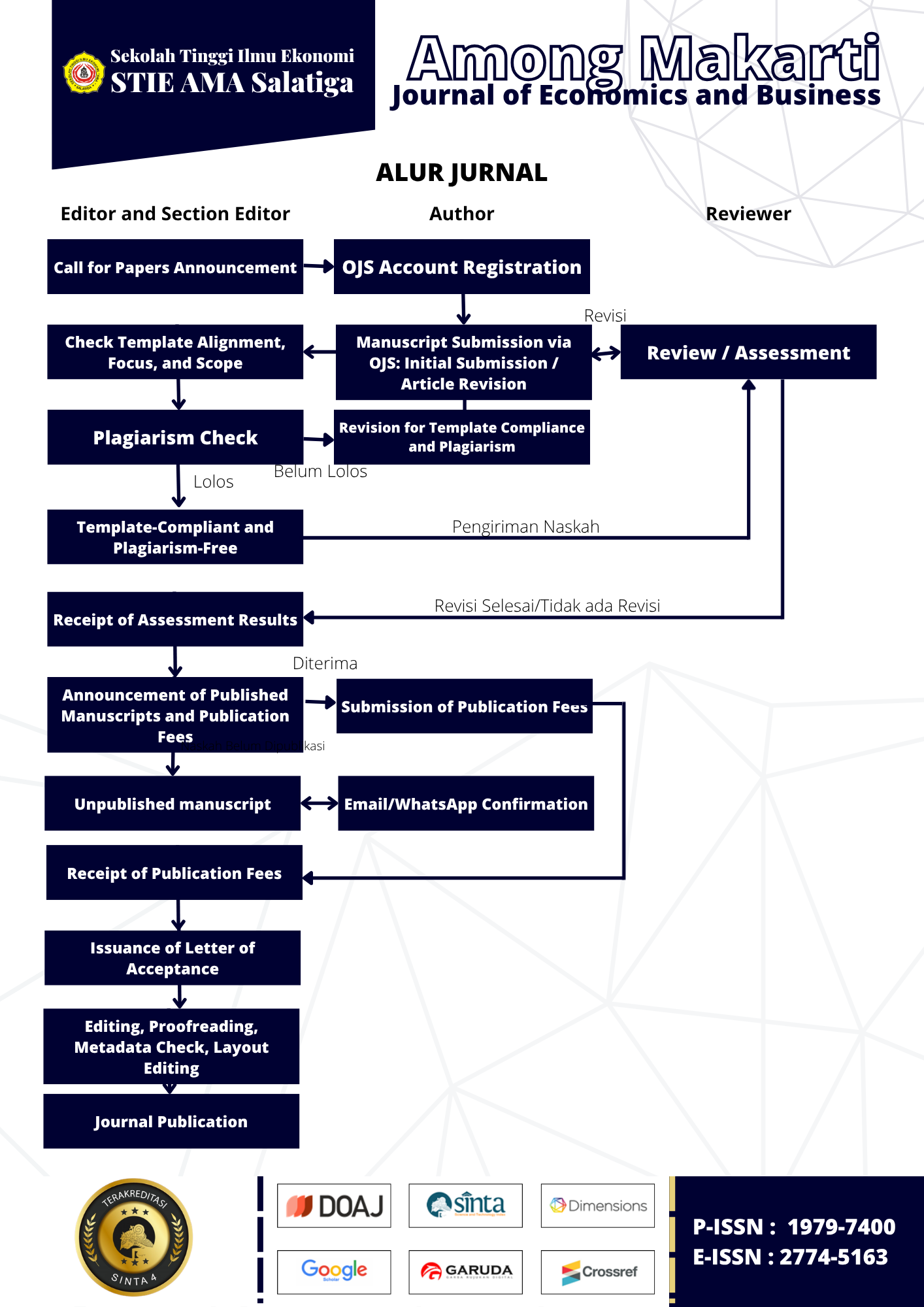
Journal Workflow

Sponsors

Journal History

Among Makarti: Journal of Economics and Business (E-ISSN and P-ISSN) is a scientific journal published by STIE AMA Salatiga. This journal publication aims to share knowledge and current issues related to research in economics and business. STIE AMA Salatiga invites academics, lecturers, and researchers to contribute scientific articles that have never been published in other journals. The manuscript is typed according to the article template and registered as the author. Editors and reviewers evaluate incoming manuscripts. The editor can change the published text for format uniformity without changing the substance. Specifically, the scope of Among Makarti's journal is Financial Management and Financial Accounting; Operational Management; HR Management and Organizational Behavior; Marketing Management; Strategic Management; Entrepreneurship; Management Information Systems; Macroeconomics and Microeconomics; SMEs; and Fintech. Address of Among Makarti: Jl. Diponegoro No. 39, Salatiga, Kec. Sidorejo, City of Salatiga, Central Java 50714, Telephone : (0298) 321013, Email: journalama@stieama.ac.id. Among Makarti: Journal of Economics and Business is published twice a year, in June and December.