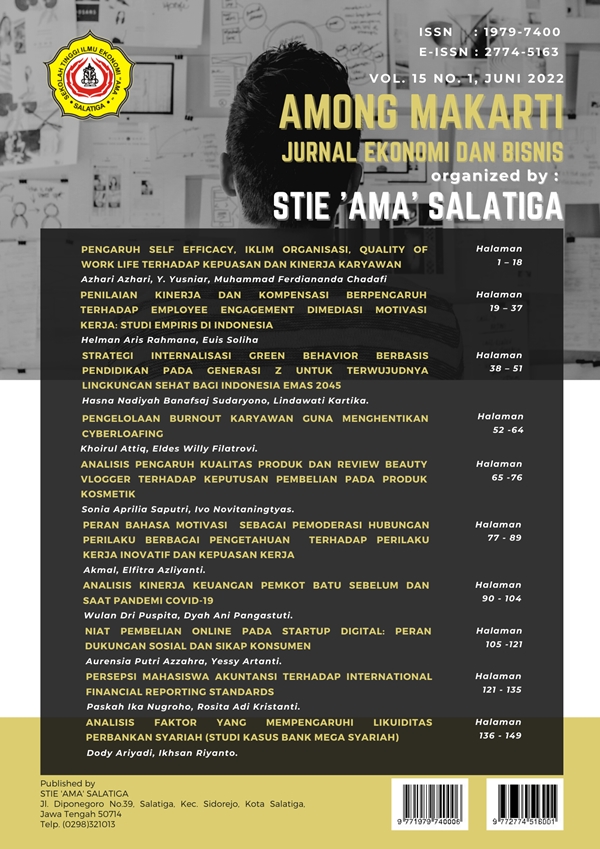
STRATEGI INTERNALISASI GREEN BEHAVIOR BERBASIS PENDIDIKAN PADA GENERASI Z UNTUK TERWUJUDNYA LINGKUNGAN SEHAT BAGI INDONESIA EMAS 2045
DOI:
https://doi.org/10.52353/ama.v15i1.228Keywords:
Environmental Performance, Green Behavior, Generasi Z, Indonesia Emas 2045, PendidikanAbstract
Indonesia is still ranked 101 out of 166 countries in achieving the SDGs. The low achievement of the SDGs is due to environmental problems driven by the low Environmental Performance Index. In addition, Indonesia has a predictable demographic bonus and the potential of Generation Z as an agent of environmental change in creating a healthy environment for Indonesia Emas 2045. Generation Z has good knowledge and interest in preserving the environment, but most of Generation Z has not implemented green behavior. The aims of this study are 1) to identify the factors causing the lack of green behavior implementation in Generation Z, 2) to analyze the role of stakeholders in the internalization of green behavior in Generation Z. 3) Design a strategy for internalizing green behavior in Generation Z. The type of data processed is secondary data with processing data using Fishbone Analysis, Stakeholder Analysis, and Analysis of The House Model. Based on the findings, the lack of green involvement is the main factor influencing the lack of green behavior implementation in Generation Z. In addition, academics as drafters and initiators are the main stakeholders. The Green Behavior Action Calendar Kit (Green-Back) program is a key strategy to internalize green behavior in Generation ZReferences
UNESCO. 2018. SETI for SDGs SCORECARD : A Tool to Assess, Monitor and Review SETI Related Project Contribution to Sustainable Development Goals, Targets and Indicators. Jakarta.
Badan Nasional Penanggulangan Bencana. (2021). Kejadian Bencana Tahun 2021. Badan Nasional Penanggulangan Bencana. https://bnpb.go.id/infografis
Badan Pusat Statistik. (2020). Hasil Sensus Penduduk 2020 (SP2020). https://www.bps.go.id/pressrelease/2021/01/21/1854/hasil-sensus-penduduk-2020.html
Boiral, O. (2009). Greening the Corporation Through Organizational Citizenship Behaviors. Journal of Business Ethics, 87(2), 221–236. https://doi.org/10.1007/S10551-008-9881-2
Capra, F., & Stone, M. K. (2010). Smart by Nature: Schooling for Sustainability. Journal of Sustainability Education. http://www.susted.com/wordpress/content/trial-author-change_2010_05/
Clear, J. (2018). Atomic Habits: an Easy & Proven Way to Build Good Habits & Break Bad Ones. Avery Publishing.
Dinas Lingkungan Hidup dan Kebersihan. (2018). 5 Permasalahan Lingkungan Hidup Indonesia dan Penyebabnya.
Elkington, J. (1998). Cannibals with Forks: The Triple Bottom Line of 21st Century Business. New Society Publishers.
Environesia. (2021). The Environmental Performance Indeks. PT.
Environesia Global Soraya. https://environesia.co.id/blog/the-environmental-performance-indeks/
Francis, T., & Hoefel, F. (2018). Generation Z characteristics and its implications for companies | McKinsey. McKinsey & Company. https://www.mckinsey.com/industries/consumer-packaged-goods/our-insights/true-gen-generation-z-and-its-implications-for-companies
Gardner, B., Lally, P., & Wardle, J. (2012). Making health habitual: The psychology of “habit-formation” and general practice. British Journal of General Practice, 62(605), 664–666. https://doi.org/10.3399/BJGP12X659466
Gaspersz, V. (2002). Total Quality Management. PT. Gramedia Pustaka Utama. https://onesearch.id/Record/IOS13409.INLIS000000000005650
Goleman, D., Bennett, L., & Barlow, Z. (2012). Ecoliterate : how educators are cultivating emotional, social, and ecological intelligence. Jossey-Bass. https://www.wiley.com/en-us/Ecoliterate%3A+How+Educators+Are+Cultivating+Emotional%2C+Social%2C+and+Ecological+Intelligence-p-9781118104576
Horovitz, J., & Ohlsson-Corboz, A.V. (2007). A Dream With a Deadline : Turning Strategy Into Action. FT Prentice Hall.
Irwan, Z. (2009). Besarnya eksploitasi perempuan dan lingkungan di Indonesia: siapa bilang. PT Elex Media Komputindo.
Johnson, B. (2013). Zero Waste Home : The Ultimate Guide to Simplifying Your Life by Reducing Your Waste. Simon and Schuster.
Komisi Nasional Indonesia untuk UNESCO. (2020). Education for Sustainable Development (ESD) – Komisi Nasional Indonesia untuk UNESCO. https://kniu.kemdikbud.go.id/?page_id=248
Kusuma, Y., & Kusuma, H. E. (2020). Hubungan Nilai-nilai Pola Pikir dan Perilaku Ramah Lingkungan Siswa Sekolah Dasar Adiwiyata. Review of Urbanism and Architectural Studies, 18(2), 24–43. https://doi.org/10.21776/UB.RUAS.2020.018.02.3
Latifah, S. W. (2020). Triple bottom line terhadap nilai perusahaan, gross profit margin sebagai indikator ekonomi. EKUITAS (Jurnal Ekonomi Dan Keuangan), 4(4), 544–563. https://doi.org/10.24034/J25485024.Y2020.V4.I4.4249
Oktari, R., & Muhammad, I. (2020). Siapkah Kamu jadi Generasi Emas 2045 | Indonesia Baik. Indonesia Baik. https://indonesiabaik.id/infografis/siapkah-kamu-jadi-generasi-emas-2045
Ostrom, E. (2010). Beyond Markets and States: Polycentric Governance of Complex Economic Systems. Transnational Corporations Review 2(2), 1–12.
Pew Research Center. (2021). Gen Z, Millennials Stand Out for Climate Change Activism, Social Media Engagement With Issue | Pew Research Center. Pew Research Center. https://www.pewresearch.org/science/2021/05/26/gen-z-millennials-stand-out-for-climate-change-activism-social-media-engagement-with-issue/
Putri, S. U., & Nikawanti, G. (2017). Pengenalan green behavior melalui ecoliteracy pada anak usia dini. Cakrawala Dini: Jurnal Pendidikan Anak Usia Dini, 8(2). https://doi.org/10.17509/CD.V8I2.10538
Race, D. & Millar, J. (2006). Training Manual : Social and Community Dimensions of ACIAR Projects. Australian Center for International Agricultural Research Institut for Land, Water, and Society of Charles Sturt Unversity.
Sudrajad, A. (2005). Pencemaran Udara, Suatu Pendahuluan. Majalah Inovasi 5(52).
Sugiarto, A., & Gabriella, D. A. (2020). Kesadaran dan Perilaku Ramah Lingkungan Mahasiswa di Kampus. Jurnal Ilmu Sosial Dan Humaniora, 9(2), 260–275. https://doi.org/10.23887/JISH-UNDIKSHA.V9I2.21061
Suratno, I. B., Darsono, D., & Mutmainah, S. (2007). Pengaruh Environmental Performance Terhadap Environmental Disclosure dan Economic Performance (Studi Empiris pada Perusahaan Manufaktur yang terdaftar di BEJ Periode 2001 - 2004). The Indonesian Journal of Accounting Research, 10(2). https://doi.org/10.33312/IJAR.174
Thaler, R. H., Sunstein, C.R. (2008). Nudge: Improving decisions about health, wealth, and happiness. Yale University Press.
Yale University. (2020). Environmental Performance Index | Environmental Performance Index. https://epi.yale.edu/epi-results/2020/component/epi
Downloads
Published
How to Cite
Issue
Section
License
Pernyataan Hak Cipta
Kesepakatan tentang Lisensi dan Hak Cipta
Dalam mengirimkan naskah ke Jurnal Among Makarti, penulis menyatakan bahwa:
Mereka telah diberi wewenang oleh rekan penulisnya untuk mengambil bagian dalam pengaturan ini.
Karya yang dideskripsikan sebelumnya belum pernah dipublikasikan secara resmi, kecuali dalam bentuk abstrak atau sebagai bagian kuliah, resensi, tesis, atau jurnal overlay yang diterbitkan.
Bahwa karya tidak sedang dipertimbangkan untuk dipublikasikan di tempat lain,
Bahwa publikasinya telah disetujui oleh semua penulis dan oleh otoritas yang berwenang – secara implisit atau eksplisit – yakni dari lembaga tempat karya tersebut dikerjakan.
Mereka menjamin adanya hak untuk mereproduksi materi yang telah diterbitkan atau dilindungi hak cipta di tempat lain.
Mereka menyetujui lisensi dan perjanjian hak cipta ini.
Hak Cipta
Penulis yang menerbitkan tulisannya di Jurnal Among Makarti menyetujui ketentuan berikut:
- Penulis memegang hak cipta dan memberikan hak publikasi pertama kepada jurnal dengan karya yang secara bersamaan dilisensikan di bawah

Creative Commons Attribution-ShareAlike 4.0 International License sehingga orang lain bisa berbagi karya dengan pengakuan kepenulisan karya itu dan publikasi awal ada pada jurnal ini. - Pemberi lisensi mengizinkan orang lain untuk membuat dan mendistribusikan karya turunan, tetapi hanya di bawah lisensi yang sama atau kompatibel.
- Pemberi lisensi mengizinkan orang lain untuk menyalin, mendistribusikan, menampilkan, dan melakukan pekerjaan, termasuk untuk tujuan komersial.
- Sebelum dan selama proses pengiriman, penulis diizinkan dan dianjurkan untuk memposting karyanya secara online (misalnya, di repositori kelembagaan atau di situs web mereka). Postingan semacam itu akan dapat menghasilkan pertukaran yang produktif, serta kutipan lebih awal dan lebih besar.
Perizinan untuk Publikasi Data
Jurnal Among Makarti menggunakan berbagai waiver (pengabaian) dan lisensi, yang secara khusus dirancang untuk dan sesuai untuk pengolahan data:
Lisensi Atribusi Open Data Commons, http://www.opendatacommons.org/licenses/by/1.0/ (default)
Creative Commons CC-Zero Waiver, http://creativecommons.org/publicdomain/zero/1.0/
Dedikasi dan Lisensi Domain Publik Open Data Commons, http://www.opendatacommons.org/licenses/pddl/1-0/
Lisensi penerbitan data lainnya dapat diizinkan sebagai pengecualian (tergantung persetujuan editor berdasarkan kasus per kasus) dan harus ditegaskan dengan pernyataan tertulis dari penulis yang akan dipublikasikan bersama artikel.
Data Terbuka dan Penerbitan serta Berbagi Perangkat Lunak
Jurnal ini berupaya untuk memaksimalkan replikabilitas penelitian yang dipublikasikan. Oleh karena itu, penulis diharuskan untuk membagikan semua data, kode, atau protokol yang mendasari penelitian yang dilaporkan dalam artikelnya. Pengecualian diperkenankan tetapi harus ditegaskan dalam pernyataan publik tertulis yang menyertai artikel tersebut.
Kumpulan data dan perangkat lunak harus disimpan dan diarsipkan secara permanen di repositori yang sesuai, tepercaya, umum, atau domain khusus (silakan lihat http://service.re3data.org dan/atau repositori perangkat lunak seperti GitHub, GitLab, Bioinformatics.org, atau sejenisnya).
Pengidentifikasi tetap terkait (misalnya DOI, atau lainnya) dari kumpulan data harus disertakan dalam data atau bagian sumber perangkat lunak artikel. Referensi kumpulan data dan perangkat lunak juga harus dimasukkan dalam daftar referensi artikel dengan DOI (jika tersedia). Jika tidak ada repositori data khusus domain, penulis harus menyimpan data mereka di repositori umum seperti ZENODO, Dryad, Dataverse, atau yang lainnya.
Data kecil juga dapat diterbitkan sebagai file data atau paket tambahan pada artikel penelitian, namun, penulis harus selalu lebih memilih deposisi dalam repositori data.