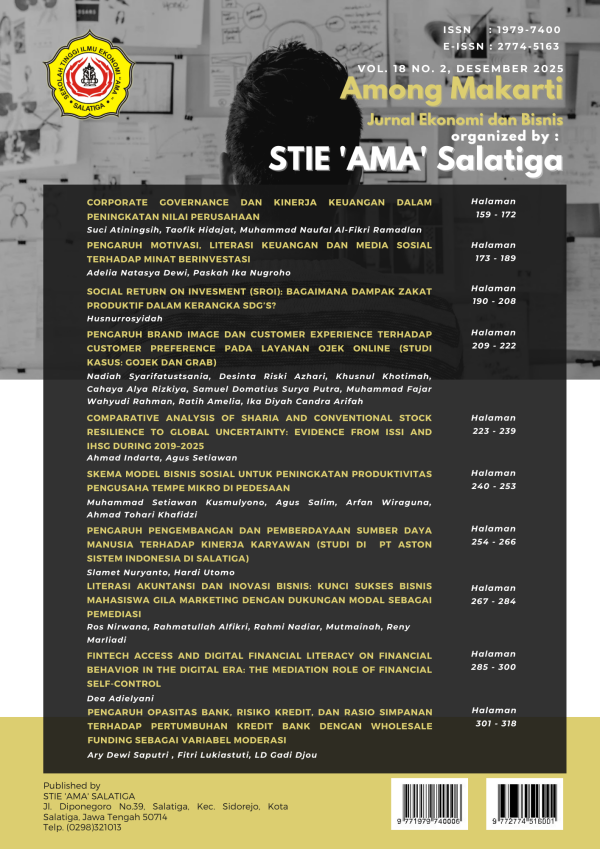
FINTECH ACCESS AND DIGITAL FINANCIAL LITERACY ON FINANCIAL BEHAVIOR IN THE DIGITAL ERA: THE MEDIATION ROLE OF FINANCIAL SELF-CONTROL
DOI:
https://doi.org/10.52353/ama.v18i2.912Keywords:
Fintech Access, Digital Financial Literacy, Gen Z's, Financial Self-Control, Financial BehaviorAbstract
ABSTRACT : This study aims to examine the impact of fintech access and digital financial literacy on financial behavior, as well as the mediating role of financial self-control in this relationship. The study adopts a deductive approach and employs a quantitative survey design for data collection and analysis. Data were collected through an online questionnaire administered to 175 Generation Z respondents in Semarang. The analysis was conducted using the Partial Least Squares Structural Equation Modeling (PLS-SEM) technique. The findings indicate that fintech access and digital literacy have a significant influence on financial behavior. Furthermore, fintech access, digital financial literacy, and financial self-control jointly affect financial behavior. The results also confirm that financial self-control plays a mediating role, acting as an indirect mechanism through which fintech access and digital financial literacy influence financial behavior. From a theoretical perspective, this study highlights the crucial role of self-control in strengthening the effects of fintech access and digital financial literacy on financial behavior in the digital financial era. From a managerial perspective, the findings suggests that improving digital financial literacy can enhance financial behavior, and therefore universities are encouraged to optimize financial education through various educational initiatives for students.
ABSTRAK : Penelitian ini bertujuan untuk menganalisis dampak akses Fintech dan literasi keuangan digital terhadap perilaku keuangan. Penelitian ini juga bertujuan untuk menganalisis dampak akses Fintech dan literasi keuangan digital terhadap perilaku keuangan dengan peran mediasi pengendalian diri keuangan. Penelitian ini mengikuti pendekatan deduktif dan menggunakan strategi survei kuantitatif untuk pengumpulan dan analisis data. Survei daring berfungsi sebagai metode untuk mengumpulkan tanggapan dari peserta. Penelitian ini melibatkan ukuran sampel 175 Gen Z di Semarang. Penelitian ini menggunakan teknik PLS SEM. Temuan menunjukkan bahwa akses Fintech dan literasi keuangan digital memengaruhi perilaku keuangan. Lebih lanjut, akses Fintech, literasi keuangan digital, dan pengendalian diri keuangan memengaruhi perilaku keuangan. Kesimpulan yang dapat ditarik adalah bahwa pengendalian diri keuangan menunjukkan peran mediasi sebagai efek tidak langsung pada faktor-faktor tersebut. Sebagai implikasi teoritis, penelitian saat ini memberikan kontribusi terhadap literatur teoritis dengan menyoroti peran penting pengendalian diri dalam meningkatkan pengaruh akses Fintech dan faktor literasi digital terhadap peran keuangan di era keuangan digital. Implikasi manajerial bahwa peningkatan literasi keuangan digital mendorong perilaku keuangan adalah bahwa universitas mengoptimalkannya melalui berbagai inisiatif pendidikan bagi mahasiswa.
References
Abdallah, W., Tfaily, F., & Harraf, A. (2025). The impact of digital financial literacy on financial behavior: customers’ perspective. Competitiveness Review, 35(2), 347–370. https://doi.org/10.1108/CR-11-2023-0297
Ajzen, I. (1991). The theory of planned behavior. Organizational Behavior and Human Decision Processes, 50(2), 179–211. https://doi.org/10.1016/0749-5978(91)90020-T
Alkhawaldeh, B. Y., Alhawamdeh, H., Al-Afeef, M. A. M., Al-Smadi, A. W., Almarshad, M., Fraihat, B. A. M., Soumadi, M. M., Nawasra, M., & Alaa, A. A. (2023). The effect of financial technology on financial performance in Jordanian SMEs: The role of financial satisfaction. Uncertain Supply Chain Management, 11(3), 1019–1030. https://doi.org/10.5267/j.uscm.2023.4.020
Altfest, L. (2004). Personal Financial Planning: Origins, Developments and a Plan for Future Direction. The American Economist, 48(2), 53–60. https://doi.org/10.1177/056943450404800204
Ameriks, J., Caplin, A., Leahy, J., & Tyler, T. (2007). Measuring Self-Control Problems. American Economic Review, 97(3), 966–972. https://doi.org/10.1257/aer.97.3.966
Anatasya, P. S., Putri, A. R., Kholifah, S., Oktavia, D. T., Febriani, D. D., & Pratama, B. C. (2024). The Influence of Financial Literacy, Lifestyle, and Self-control on Student Consumptive Behavior. Asian Journal of Economics, Business and Accounting, 24(9), 135–145. https://doi.org/10.9734/ajeba/2024/v24i91482
Ardyansyah, A. F., & Indrawati, N. K. (2024). Perception and Practices of Personal Financial Management among Generation Z in Indonesia. Journal Research of Social Science, Economics, and Management, 3(12), 2116–2126. https://doi.org/10.59141/jrssem.v3i12.687
Azzam, M. J., Alqudah, A. M. M., Aryan, L. A., & Abu Haija, A. A. (2024). Empirical Analysis of the Link Between Financial Literacy and Personal Financial Decision of Gen Z (pp. 179–192). https://doi.org/10.1007/978-3-031-73545-5_16
Baker, H. K., Filbeck, G., & Ricciardi, V. (2017). Financial behavior: Players, services, products, and markets. Oxford University Press.
Bhat, M. A., Khan, S. T., Alkhwaldi, A. F., & Abdulmuhsin, A. A. (2024). Investigating the critical drivers of Fintech adoption to promote business sustainability of SMEs. Global Knowledge, Memory and Communication, October 2025. https://doi.org/10.1108/GKMC-02-2024-0096
Birkenmaier, J., Fu, Q. (John), & -, Q. (John) F. T. T. (2023). Financial access and financial Behavior. In A Research Agenda for Consumer Financial Behavior (pp. 89-102 VO-None). Edward Elgar Publishing. https://ideas.repec.org/h/elg/eechap/21534_7.html
Bu, D., Hanspal, T., Liao, Y., & Liu, Y. (2019). Financial Literacy and Self-Control in FinTech: Evidence from a Field Experiment on Online Consumer Borrowing. In SSRN Electronic Journal. https://doi.org/10.2139/ssrn.3469571
Byegon, G. (2020). Linkage Between Self-Control, Financial Innovations and Financial Inclusion. A Moderated Mediation Analysis Across Levels of Financial Literacy (The case of owners of Microenterprise in Kenya). European Journal of Business and Management Research, 5(4). https://doi.org/10.24018/ejbmr.2020.5.4.294
Chandra, W., & Pamungkas, A. S. (2023). The Influence of Attitude Toward Money, Locus of Control, Financial Self-Efficacy and Self-Control on Financial Management Behavior. International Journal of Application on Economics and Business, 1(1), 578–587. https://doi.org/10.24912/ijaeb.v1i1.578-587
Choung, Y., Chatterjee, S., & Pak, T. Y. (2023). Digital financial literacy and financial well-being. Finance Research Letters, 58, 104438. https://doi.org/10.1016/j.frl.2023.104438
Choung, Y., Pak, T. Y., & Chatterjee, S. (2025). Digital Financial Literacy and Life Satisfaction: Evidence from South Korea. Behavioral Sciences, 15(1), 1–15. https://doi.org/10.3390/bs15010094
Cobb-Clark, D. A., Kong, N., & Schildberg-Hörisch, H. (2023). The stability of self-control in a population-representative study. Journal of Economic Psychology, 95, 102599. https://doi.org/10.1016/j.joep.2022.102599
Dew, J., & Jian Xiao, J. (2013). The Financial Management Behavior Scale: Development and Validation. In Article in Journal of Financial Counseling and Planning. https://www.researchgate.net/publication/256019544
Dogra, P., Kaushal, A., & Sharma, R. R. (2023). Antecedents of the Youngster’s Awareness About Financial Literacy: A Structure Equation Modelling Approach. Vision: The Journal of Business Perspective, 27(1), 48–62. https://doi.org/10.1177/0972262921996560
Dovie, D. A. (2018). Utilization of Digital Literacy in Retirement Planning Among Ghanaian Formal and Informal Sector Workers. Interações: Sociedade e as Novas Modernidades, 34, 113–140. https://doi.org/10.31211/interacoes.n34.2018.a6
Farida, M. N., Soesatyo, Y., & Aji, T. S. (2021). Influence of Financial Literacy and Use of Financial Technology on Financial Satisfaction through Financial Behavior. International Journal of Education and Literacy Studies, 9(1), 86. https://doi.org/10.7575/aiac.ijels.v.9n.1p.86
Ferdinand, A. (2014). Metode Penelitian Manajemen. Badan Penerbit Universitas Diponegoro.
Fred van Raaij, W., Riitsalu, L., & Põder, K. (2023). Direct and indirect effects of self-control and future time perspective on financial well-being. Journal of Economic Psychology, 99, 102667. https://doi.org/10.1016/j.joep.2023.102667
Gafoor, A., & Amilan, S. (2024). Fintech adoption and financial well-being of persons with disabilities: the mediating role of financial access, financial knowledge and financial behaviour. International Journal of Social Economics, 51(11), 1388–1401. https://doi.org/10.1108/IJSE-08-2023-0596
Ghozali, I., & Latan, H. (2015). Partial Least Squares, Konsep, Teknik, dan Aplikasi Menggunakan SmartPLS 3.0 untuk Penelitian Empiris. Badan Penerbit UNDIP.
Hair, J. F., Black, W. C., Babin, B. J., Anderson, R. E., & Tatham, R. L. (2014). Multivariate data analysis, new international edition. In Harlow: Pearson Education. Pearson Education Limited. https://vdoc.pub/documents/multivariate-data-analysis-3nmu0fr2p8cg
Hasan, M., Noor, T., Gao, J., Usman, M., & Abedin, M. Z. (2023). Rural Consumers’ Financial Literacy and Access to FinTech Services. Journal of the Knowledge Economy, 14(2), 780–804. https://doi.org/10.1007/s13132-022-00936-9
Hidayat, G., & Hermawan, A. (2025). Behavioral Factors Affecting Personal Financial Management and Savings Habits: a Case Study of Gen Z. Jurnal Riset Bisnis Dan Manajemen, 18(2), 240–249. https://doi.org/10.23969/jrbm.v18i2.22278
Indrawati, A. (2021). Digital financial literacy, and financial technology: Case studies of faculty of economics university 17 August 1945 Samarinda. Jurnal Ilmu Ekonomi Dan Manajemen, 12(1), 1–10. http://jurnal.untag-sby.ac.id/index.php/die/index
Jalal, A., Al Mubarak, M., & Durani, F. (2024). Financial Technology (Fintech) (pp. 525–536). https://doi.org/10.1007/978-3-031-35828-9_45
Jhonson, B., Andriani, R., Noviana, I., & Tamara, D. (2023). The Influence of Digital Financial Literacy on Financial Well-Being through Spending, Saving, and Investment Behavior in Indonesia. Ournal of Business Studies and Management Review, 6(2), 157–168. https://doi.org/10.22437/jbsmr.v6i2.24793
Kargas, A., Gkika, E. C., & Sepetis, A. (2024). Exploring Digital Transformation Intensity and Its Relationship with Sustainability: Greek Managers’ Perspectives. Sustainability (Switzerland), 16(14). https://doi.org/10.3390/su16146077
Kartawinata, B. R., Pratiwi, K. A., Akbar, A., & Maharani, D. (2024). Financial literacy, self-control, and consumptive behavior in using mobile banking services by Generation Z in Indonesia. In J. Jaiswal (Ed.), International Conference on Medical Imaging, Electronic Imaging, Information Technologies, and Sensors (MIEITS 2024) (p. 40). SPIE. https://doi.org/10.1117/12.3030877
Kass-Hanna, J., Lyons, A. C., & Liu, F. (2022). Building financial resilience through financial and digital literacy in South Asia and Sub-Saharan Africa. Emerging Markets Review, 51, 100846. https://doi.org/10.1016/j.ememar.2021.100846
Khoirunnisaa, J., & Johan, I. R. (2020). The Effects of Financial Literacy and Self-Control towards Financial Behavior among High School Students in Bogor. Journal of Consumer Sciences, 5(2), 73–86. https://doi.org/10.29244/jcs.5.2.73-86
Koskelainen, T., Kalmi, P., Scornavacca, E., & Vartiainen, T. (2023). Financial literacy in the digital age—A research agenda. Journal of Consumer Affairs, 57(1), 507–528. https://doi.org/10.1111/joca.12510
Lusardi, A., & Mitchell, O. S. (2014). The economic importance of financial literacy: Theory and evidence. Journal of Economic Literature, 52(1), 5–44. https://doi.org/10.1257/jel.52.1.5
Lyons, A. C., & Kass‐Hanna, J. (2021). A methodological overview to defining and measuring “digital” financial literacy. FINANCIAL PLANNING REVIEW, 4(2). https://doi.org/10.1002/cfp2.1113
McBeth, M. K. (2022). Coddled or Engaged? Teaching Political Tolerance to Generation Z Students. Journal of Political Science Education, 18(4), 438–454. https://doi.org/10.1080/15512169.2022.2097915
Mpaata, E., Koske, N., & Saina, E. (2023). Does self-control moderate financial literacy and savings behavior relationship? A case of micro and small enterprise owners. Current Psychology, 42(12), 10063–10076. https://doi.org/10.1007/s12144-021-02176-7
Nguyen, D. K., Sermpinis, G., & Stasinakis, C. (2023). Big data, artificial intelligence and machine learning: A transformative symbiosis in favour of financial technology. European Financial Management, 29(2), 517–548. https://doi.org/10.1111/eufm.12365
Nguyen Ngoc, T., Viet Dung, M., Rowley, C., & Pejić Bach, M. (2022). Generation Z job seekers’ expectations and their job pursuit intention: Evidence from transition and emerging economy. International Journal of Engineering Business Management, 14, 1–13. https://doi.org/10.1177/18479790221112548
Pangestu, S., & Karnadi, E. B. (2020). The effects of financial literacy and materialism on the savings decision of generation Z Indonesians. Cogent Business and Management, 7(1), 1743618. https://doi.org/10.1080/23311975.2020.1743618
Peetz, J., & Davydenko, M. (2021). Financial self-control strategy use: Generating personal strategies reduces spending more than learning expert strategies. Journal of Experimental Social Psychology, 97, 104189. https://doi.org/10.1016/j.jesp.2021.104189
Rahayu, R., Ali, S., Aulia, A., & Hidayah, R. (2022). The Current Digital Financial Literacy and Financial Behavior in Indonesian Millennial Generation. Journal of Accounting and Investment, 23(1), 78–94. https://doi.org/10.18196/jai.v23i1.13205
Rahayu, R., Juita, V., Rahman, A., Fitriamiranti, S., & Rafles, R. (2022). The level of digital financial literacy and financial well-being of people in West Sumatra Indonesia. Operations Management and Information System Studies, 2(2), 66–76.
Rey-Ares, L., Fernández-López, S., Castro-González, S., & Rodeiro-Pazos, D. (2021). Does self-control constitute a driver of millennials’ financial behaviors and attitudes? Journal of Behavioral and Experimental Economics, 93, 101702. https://doi.org/10.1016/j.socec.2021.101702
Rumyati Zeinab, & Ruski. (2025). The Role of Fintech E-Wallet and Self-Control on Generation Z’s Consumptive Behavior in Bangkalan: Efforts to Educate and Literacy in Digital Finance. Journal of Practice Learning and Educational Development, 5(2), 506–513. https://doi.org/10.58737/jpled.v5i2.472
Sampson, E. E. (1981). Cognitive psychology as ideology. American Psychologist, 36(7), 730. https://psycnet.apa.org/doi/10.1037/0003-066X.36.7.730
Sekścińska, K., Rudzinska-Wojciechowska, J., & Jaworska, D. (2021). Self-control and financial risk taking. Journal of Economic Psychology, 85(April), 102386. https://doi.org/10.1016/j.joep.2021.102386
YÜRÜK, M. F. (2025). Mediating roles of financial literacy, self-control, and peer influence on investment behavior: Turkish university students. Social Sciences & Humanities Open, 12(November), 102238. https://doi.org/10.1016/j.ssaho.2025.102238
Zahari, Y. K., Reza Arviciena Sakti, Abdul Basit, & Oliver William Knight. (2025). Financial Literacy, Financial Attitudes, and Self-Control Towards Financial Management Practice in MSME In West Nusa Tenggara. Jurnal Magister Ekonomi Syariah, 4(1 Juni), 1–17. https://doi.org/10.14421/jmes.2025.041-01
Downloads
Published
How to Cite
Issue
Section
License
Pernyataan Hak Cipta
Kesepakatan tentang Lisensi dan Hak Cipta
Dalam mengirimkan naskah ke Jurnal Among Makarti, penulis menyatakan bahwa:
Mereka telah diberi wewenang oleh rekan penulisnya untuk mengambil bagian dalam pengaturan ini.
Karya yang dideskripsikan sebelumnya belum pernah dipublikasikan secara resmi, kecuali dalam bentuk abstrak atau sebagai bagian kuliah, resensi, tesis, atau jurnal overlay yang diterbitkan.
Bahwa karya tidak sedang dipertimbangkan untuk dipublikasikan di tempat lain,
Bahwa publikasinya telah disetujui oleh semua penulis dan oleh otoritas yang berwenang – secara implisit atau eksplisit – yakni dari lembaga tempat karya tersebut dikerjakan.
Mereka menjamin adanya hak untuk mereproduksi materi yang telah diterbitkan atau dilindungi hak cipta di tempat lain.
Mereka menyetujui lisensi dan perjanjian hak cipta ini.
Hak Cipta
Penulis yang menerbitkan tulisannya di Jurnal Among Makarti menyetujui ketentuan berikut:
- Penulis memegang hak cipta dan memberikan hak publikasi pertama kepada jurnal dengan karya yang secara bersamaan dilisensikan di bawah

Creative Commons Attribution-ShareAlike 4.0 International License sehingga orang lain bisa berbagi karya dengan pengakuan kepenulisan karya itu dan publikasi awal ada pada jurnal ini. - Pemberi lisensi mengizinkan orang lain untuk membuat dan mendistribusikan karya turunan, tetapi hanya di bawah lisensi yang sama atau kompatibel.
- Pemberi lisensi mengizinkan orang lain untuk menyalin, mendistribusikan, menampilkan, dan melakukan pekerjaan, termasuk untuk tujuan komersial.
- Sebelum dan selama proses pengiriman, penulis diizinkan dan dianjurkan untuk memposting karyanya secara online (misalnya, di repositori kelembagaan atau di situs web mereka). Postingan semacam itu akan dapat menghasilkan pertukaran yang produktif, serta kutipan lebih awal dan lebih besar.
Perizinan untuk Publikasi Data
Jurnal Among Makarti menggunakan berbagai waiver (pengabaian) dan lisensi, yang secara khusus dirancang untuk dan sesuai untuk pengolahan data:
Lisensi Atribusi Open Data Commons, http://www.opendatacommons.org/licenses/by/1.0/ (default)
Creative Commons CC-Zero Waiver, http://creativecommons.org/publicdomain/zero/1.0/
Dedikasi dan Lisensi Domain Publik Open Data Commons, http://www.opendatacommons.org/licenses/pddl/1-0/
Lisensi penerbitan data lainnya dapat diizinkan sebagai pengecualian (tergantung persetujuan editor berdasarkan kasus per kasus) dan harus ditegaskan dengan pernyataan tertulis dari penulis yang akan dipublikasikan bersama artikel.
Data Terbuka dan Penerbitan serta Berbagi Perangkat Lunak
Jurnal ini berupaya untuk memaksimalkan replikabilitas penelitian yang dipublikasikan. Oleh karena itu, penulis diharuskan untuk membagikan semua data, kode, atau protokol yang mendasari penelitian yang dilaporkan dalam artikelnya. Pengecualian diperkenankan tetapi harus ditegaskan dalam pernyataan publik tertulis yang menyertai artikel tersebut.
Kumpulan data dan perangkat lunak harus disimpan dan diarsipkan secara permanen di repositori yang sesuai, tepercaya, umum, atau domain khusus (silakan lihat http://service.re3data.org dan/atau repositori perangkat lunak seperti GitHub, GitLab, Bioinformatics.org, atau sejenisnya).
Pengidentifikasi tetap terkait (misalnya DOI, atau lainnya) dari kumpulan data harus disertakan dalam data atau bagian sumber perangkat lunak artikel. Referensi kumpulan data dan perangkat lunak juga harus dimasukkan dalam daftar referensi artikel dengan DOI (jika tersedia). Jika tidak ada repositori data khusus domain, penulis harus menyimpan data mereka di repositori umum seperti ZENODO, Dryad, Dataverse, atau yang lainnya.
Data kecil juga dapat diterbitkan sebagai file data atau paket tambahan pada artikel penelitian, namun, penulis harus selalu lebih memilih deposisi dalam repositori data.