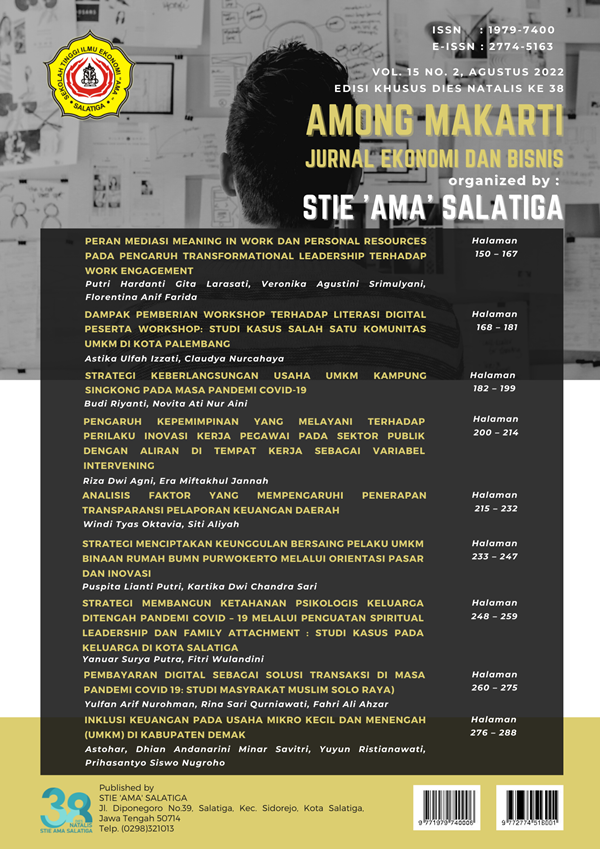
STRATEGI MEMBANGUN KETAHANAN PSIKOLOGIS KELUARGA DITENGAH PANDEMI COVID – 19 MELALUI PENGUATAN SPIRITUAL LEADERSHIP DAN FAMILY ATTACHMENT : STUDI KASUS PADA KELUARGA DI KOTA SALATIGA
DOI:
https://doi.org/10.52353/ama.v15i2.329Keywords:
Psychological Resilience, Spiritual Leadership, Family Attachment, Family Well – being.Abstract
This study is an experiment to develop a model of family psychological resilience through the role of spiritual leadership and family attachment. Therefore, the respondents used in this study were family members in Salatiga. Data were collected from 171 family members using a questionnaire. The analytical tool used is path analysis, and the results of this study reveal that spiritual leadership and family attachment have a significant and positive relationship to psychological resilience. Second, family well-being as a mediating construct fully mediates the relationship between spiritual leadership and family attachment to family psychological resilience. Finally, this study offers empirical evidence on how to develop family psychological resilience in Salatiga. Another fact that needs to be underlined from this research is that psychological resilience is one of the keys to creating resilience during this pandemic.References
Agung, I. M. (2020). Memahami Pandemi Covid-19 Dalam Perspektif Psikologi Sosial. Psikobuletin:Buletin Ilmiah Psikologi.
Amir, M. T., & Standen, P. (2019). Growth-focused resilience: development and validation of a new scale. Management Research Review. https://doi.org/10.1108/MRR-04-2018-0151
Baker, M., Gruber, J., & Milligan, K. (2008). Universal child care, matemal labor supply, and family well-being. Journal of Political Economy. https://doi.org/10.1086/591908
Campbell-Sills, L., Cohan, S. L., & Stein, M. B. (2006). Relationship of resilience to personality, coping, and psychiatric symptoms in young adults. Behaviour Research and Therapy. https://doi.org/10.1016/j.brat.2005.05.001
Chin, W. W., & Dibbern, J. (2010). An Introduction to a Permutation Based Procedure for Multi-Group PLS Analysis: Results of Tests of Differences on Simulated Data and a Cross Cultural Analysis of the Sourcing of Information System Services Between Germany and the USA. In Handbook of Partial Least Squares. https://doi.org/10.1007/978-3-540-32827-8_8
Connor, K. M., & Davidson, J. R. T. (2003). Development of a new Resilience scale: The Connor-Davidson Resilience scale (CD-RISC). Depression and Anxiety. https://doi.org/10.1002/da.10113
Cuvelier, L., & Falzon, P. (2016). Resilience As Resource-based Design Of Anticipated Situations. In Proceedings of the fourth Resilience Engineering Symposium. https://doi.org/10.4000/books.pressesmines.982
Dewi, D. S. E., & Hamzah, H. B. (2019). The Relationship between Spirituality, Quality of Life, and Resilience. https://doi.org/10.2991/iccd-19.2019.39
Ekşi, H., & Kardaş, S. (2017). Spiritual Well-Being: Scale Development and Validation. Spiritual Psychology and Counseling. https://doi.org/10.12738/spc.2017.1.0022
Fahrudin, A., Jakarta, U. M., Susilowati, E., Kesejahteraan, P., Bandung, S., Erlangga, H., Pasundan, U., Wardani, L., & Buana, U. M. (2020). Peranan keluarga dalam menghadapi pandemi covid-19 di indonesia. Covid-19: Pandemi Dalam Banyak Wajah, Agustus, 111–117.
Fry, L. W. (2003). Toward a theory of spiritual leadership. Leadership Quarterly. https://doi.org/10.1016/j.leaqua.2003.09.001
Goldberg, S. (2018). Origins of attachment theory. In Attachment and development. https://doi.org/10.4324/9780203783832-1
Hair, J. F., Black, W. C., Babin, B. J., & Anderson, R. E. (2017). Multivariate Data Analysis: Seventh Edition. In Prentice Hall.
Iskandarsyah, A., & Yudiana, W. (2020). Informasi COVID-19, Perilaku Sehat Dan Kondisi Psikologis Di Indonesia.
Lee, J. H., Nam, S. K., Kim, A. R., Kim, B., Lee, M. Y., & Lee, S. M. (2013). Resilience: A meta-analytic approach. Journal of Counseling and Development. https://doi.org/10.1002/j.1556-6676.2013.00095.x
Li, S., Wang, Y., Xue, J., Zhao, N., & Zhu, T. (2020). The impact of covid-19 epidemic declaration on psychological consequences: A study on active weibo users. International Journal of Environmental Research and Public Health. https://doi.org/10.3390/ijerph17062032
Luthar, S. S. (2006). Resilience in Development: A Synthesis of Research across Five Decades. In Developmental Psychopathology: Second Edition. https://doi.org/10.1002/9780470939406.ch20
Masten, A. S., & Obradović, J. (2006). Competence and resilience in development. Annals of the New York Academy of Sciences. https://doi.org/10.1196/annals.1376.003
Mawarpury, M., & Mirza, M. (2017). RESILIENSI DALAM KELUARGA: PERSPEKTIF PSIKOLOGI. Psikoislamedia : Jurnal Psikologi. https://doi.org/10.22373/psikoislamedia.v2i1.1829
McAdam, J. (2013). Coping and adaptation: A narrative analysis of children and youth from zones of conflict in Africa. In Handbook of Resilience in Children of War. https://doi.org/10.1007/978-1-4614-6375-7_12
Mujiyanto, F. I. (2016). Family well-being pada keluarga yang ditinggal berurbanisasi di desa Kalikabong Kecamatan Kalimanah Kabupaten Purbalingga. In Journal of Chemical Information and Modeling. Universitas Muhammadiyah Purwokerto.
Näswall, K., Malinen, S., Kuntz, J., & Hodliffe, M. (2019). Employee resilience: development and validation of a measure. Journal of Managerial Psychology. https://doi.org/10.1108/JMP-02-2018-0102
Nisrina, H. E., Faruq, M. I., Masruroh, R., Nurlatifah, S. S., & Nisa, S. K. (2020). Konstruksi Alat Ukur Kepemimpinan Spiritual dalam Keluarga. Jurnal Psikologi Islam Dan Budaya. https://doi.org/10.15575/jpib.v3i1.6526
Palazzeschi, L., Bucci, O., & Di Fabio, A. (2018). Re-thinking innovation in organizations in the industry 4.0 scenario: New challenges in a primary prevention perspective. Frontiers in Psychology. https://doi.org/10.3389/fpsyg.2018.00030
Rajkumar, R. P. (2020). Attachment theory and psychological responses to the covid-19 pandemic: A narrative review. In Psychiatria Danubina. https://doi.org/10.24869/PSYD.2020.256
Thomas, P. A., Liu, H., & Umberson, D. (2017). Family Relationships and Well-Being. Innovation in Aging. https://doi.org/10.1093/geroni/igx025
Vrtička, P., & Vuilleumier, P. (2012). Neuroscience of human social interactions and adult attachment style. In Frontiers in Human Neuroscience. https://doi.org/10.3389/fnhum.2012.00212
Walsh, F. (2016). Family resilience: a developmental systems framework. European Journal of Developmental Psychology. https://doi.org/10.1080/17405629.2016.1154035
Wang, C., Pan, R., Wan, X., Tan, Y., Xu, L., Ho, C. S., & Ho, R. C. (2020). Immediate psychological responses and associated factors during the initial stage of the 2019 coronavirus disease (COVID-19) epidemic among the general population in China. International Journal of Environmental Research and Public Health. https://doi.org/10.3390/ijerph17051729
White, B., Driver, S., & Warren, A. M. (2010). Resilience and Indicators of Adjustment During Rehabilitation From a Spinal Cord Injury. Rehabilitation Psychology. https://doi.org/10.1037/a0018451
Downloads
Published
Issue
Section
License
Pernyataan Hak Cipta
Kesepakatan tentang Lisensi dan Hak Cipta
Dalam mengirimkan naskah ke Jurnal Among Makarti, penulis menyatakan bahwa:
Mereka telah diberi wewenang oleh rekan penulisnya untuk mengambil bagian dalam pengaturan ini.
Karya yang dideskripsikan sebelumnya belum pernah dipublikasikan secara resmi, kecuali dalam bentuk abstrak atau sebagai bagian kuliah, resensi, tesis, atau jurnal overlay yang diterbitkan.
Bahwa karya tidak sedang dipertimbangkan untuk dipublikasikan di tempat lain,
Bahwa publikasinya telah disetujui oleh semua penulis dan oleh otoritas yang berwenang – secara implisit atau eksplisit – yakni dari lembaga tempat karya tersebut dikerjakan.
Mereka menjamin adanya hak untuk mereproduksi materi yang telah diterbitkan atau dilindungi hak cipta di tempat lain.
Mereka menyetujui lisensi dan perjanjian hak cipta ini.
Hak Cipta
Penulis yang menerbitkan tulisannya di Jurnal Among Makarti menyetujui ketentuan berikut:
- Penulis memegang hak cipta dan memberikan hak publikasi pertama kepada jurnal dengan karya yang secara bersamaan dilisensikan di bawah

Creative Commons Attribution-ShareAlike 4.0 International License sehingga orang lain bisa berbagi karya dengan pengakuan kepenulisan karya itu dan publikasi awal ada pada jurnal ini. - Pemberi lisensi mengizinkan orang lain untuk membuat dan mendistribusikan karya turunan, tetapi hanya di bawah lisensi yang sama atau kompatibel.
- Pemberi lisensi mengizinkan orang lain untuk menyalin, mendistribusikan, menampilkan, dan melakukan pekerjaan, termasuk untuk tujuan komersial.
- Sebelum dan selama proses pengiriman, penulis diizinkan dan dianjurkan untuk memposting karyanya secara online (misalnya, di repositori kelembagaan atau di situs web mereka). Postingan semacam itu akan dapat menghasilkan pertukaran yang produktif, serta kutipan lebih awal dan lebih besar.
Perizinan untuk Publikasi Data
Jurnal Among Makarti menggunakan berbagai waiver (pengabaian) dan lisensi, yang secara khusus dirancang untuk dan sesuai untuk pengolahan data:
Lisensi Atribusi Open Data Commons, http://www.opendatacommons.org/licenses/by/1.0/ (default)
Creative Commons CC-Zero Waiver, http://creativecommons.org/publicdomain/zero/1.0/
Dedikasi dan Lisensi Domain Publik Open Data Commons, http://www.opendatacommons.org/licenses/pddl/1-0/
Lisensi penerbitan data lainnya dapat diizinkan sebagai pengecualian (tergantung persetujuan editor berdasarkan kasus per kasus) dan harus ditegaskan dengan pernyataan tertulis dari penulis yang akan dipublikasikan bersama artikel.
Data Terbuka dan Penerbitan serta Berbagi Perangkat Lunak
Jurnal ini berupaya untuk memaksimalkan replikabilitas penelitian yang dipublikasikan. Oleh karena itu, penulis diharuskan untuk membagikan semua data, kode, atau protokol yang mendasari penelitian yang dilaporkan dalam artikelnya. Pengecualian diperkenankan tetapi harus ditegaskan dalam pernyataan publik tertulis yang menyertai artikel tersebut.
Kumpulan data dan perangkat lunak harus disimpan dan diarsipkan secara permanen di repositori yang sesuai, tepercaya, umum, atau domain khusus (silakan lihat http://service.re3data.org dan/atau repositori perangkat lunak seperti GitHub, GitLab, Bioinformatics.org, atau sejenisnya).
Pengidentifikasi tetap terkait (misalnya DOI, atau lainnya) dari kumpulan data harus disertakan dalam data atau bagian sumber perangkat lunak artikel. Referensi kumpulan data dan perangkat lunak juga harus dimasukkan dalam daftar referensi artikel dengan DOI (jika tersedia). Jika tidak ada repositori data khusus domain, penulis harus menyimpan data mereka di repositori umum seperti ZENODO, Dryad, Dataverse, atau yang lainnya.
Data kecil juga dapat diterbitkan sebagai file data atau paket tambahan pada artikel penelitian, namun, penulis harus selalu lebih memilih deposisi dalam repositori data.