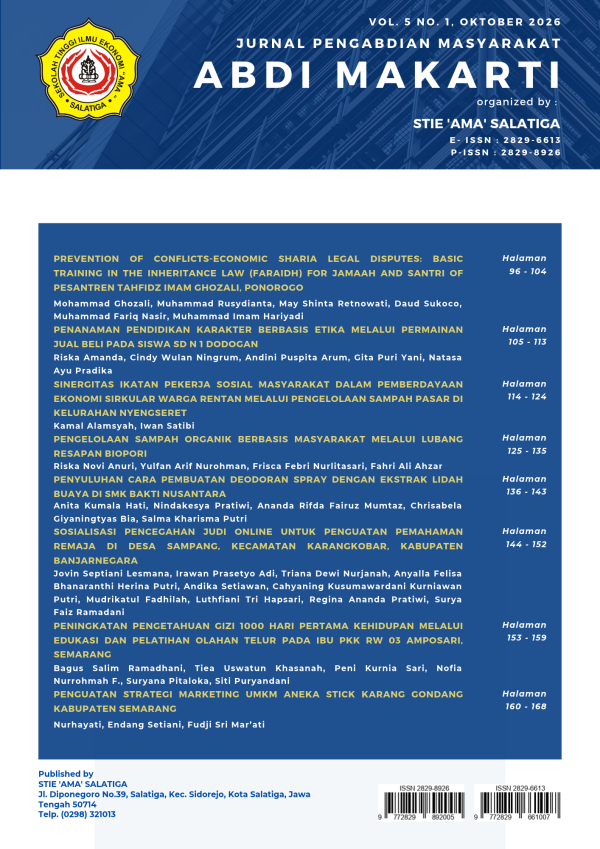
PENGELOLAAN SAMPAH ORGANIK BERBASIS MASYARAKAT MELALUI LUBANG RESAPAN BIOPORI
DOI:
https://doi.org/10.52353/abdimakarti.v5i2.1033Kata Kunci:
waste management, organic waste, biopore infiltration holes, environmental sustainability.Abstrak
Household waste management in Dukuh Bladon, Desa Pepe, Klaten Regency, still faces challenges regarding the disposal and burning of organic waste, practices that pose a risk of environmental pollution. This situation highlights the need to enhance community knowledge and skills regarding waste management through simple, sustainable methods. This community service initiative aims to improve the community's understanding and skills in organic waste management by utilizing biopore infiltration holes (LRB). The activity employed a participatory educational approach, encompassing problem identification, outreach, education on waste sorting, demonstrations and hands-on practice in creating LRBs, organic waste utilization, and guidance on LRB maintenance. The results indicate that LRBs offer an alternative for processing organic waste through decomposition while simultaneously supporting water infiltration and producing organic material that can potentially be used as compost on agricultural land. The initiative also demonstrates that integrating education with LRB implementation can serve as a simple alternative to support community-based waste management and environmental sustainability.
Referensi
Adhitya, B., Megasukma, Y., Lagowa, M. I., Prabawa, A. D., Wiratama, J., & Putri, A. A. (2025). Assistance Of Biopore Technology as a Rainwater Infiltration Method to Reduce Surface Runoff and Flooding. Transformasi: Jurnal Pengabdian Masyarakat, 21(1). https://doi.org/10.20414/transformasi.v21i1.12875
BPS Klaten. (2024). Data Strategis Kabupaten Klaten 2020-2024. https://klatenkab.bps.go.id/id/publication/2024/12/31/3813cd856e3650f9faa7c070/data-strategis-kabupaten-klaten-2020-2024.html
Cucina, M. (2023). Integrating anaerobic digestion and composting to boost energy and material recovery from organic wastes in the Circular Economy framework in Europe: A review. Bioresource Technology Reports, 24, 101642. https://doi.org/10.1016/j.biteb.2023.101642
Farahdiba, A. U., Warmadewanthi, I. D. A. A., Fransiscus, Y., Rosyidah, E., Hermana, J., & Yuniarto, A. (2023). The present and proposed sustainable food waste treatment technology in Indonesia: A review. Environmental Technology & Innovation, 32, 103256. https://doi.org/10.1016/j.eti.2023.103256
Fitria, T. N. (2024). Household Waste Management Through a Waste Bank System to Increase Household Income for Residents of Dukuh Pondok Serang Mulur. Budimas, 6(3). https://doi.org/10.46807/aspirasi.v5i1.447
Ghazali, Tjakraatmadja, J. H., Sunarti, & Pratiwi. (2022). Resident-Based Learning Model for Sustainable Resident Participation in Municipal Solid Waste Management Program. Global Journal of Environmental Science and Management, 7(4), 599–624. https://doi.org/10.22034/gjesm.2021.04.08
Jakhar, R., Samek, L., & Styszko, K. (2023). A Comprehensive Study of the Impact of Waste Fires on the Environment and Health. In Sustainability (Vol. 15, Issue 19, p. 14241). https://doi.org/10.3390/su151914241
Kementerian Lingkungan Hidup. (2026). Statistik Pengelolaan Sampah. Sampahnasional.Kemenlh.Go.Id. https://sampahnasional.kemenlh.go.id/
Kicińska, A., Caba, G., & Barria-Parra, F. (2024). Burning of Municipal Waste in Household Furnaces and The Health of Their Owners. Scientific Reports, 14(1), 32011. https://doi.org/10.1038/s41598-024-83572-4
Kiran, Ramaraju H K, & S, P. (2026). Integrating Pit Composting with Sustainable Agriculture: A Review ff Decentralized Urban Wet Waste Management In India. Cities & Health, 10(1), 202–219. https://doi.org/10.1080/23748834.2025.2584745
Lolo, E. U., Gunawan, R. I., & Yanuranda, A. (2023). Processing of Organic Waste Using Biopori Infiltration Holes ( Case Study : Organic Waste at Christian University of Technology Solo ). East Asian Journal of Multidisciplinary Research (EAJMR), 2(4), 1675–1688.
Naharuddin, N., Massiri, S. D., Pribadi, H., Maiwa, A., & Ihsan, M. (2024). Evaluation of Rainwater Harvesting and Bio-pore Infiltration Holes for Flood Mitigation and Soil Conservation. Journal of Civil and Hydraulic Engineering, 2(3), 142–150. https://doi.org/10.56578/jche020302.
Nanda, A. R., Mansida, A., Gaffar, F., & Bancong, H. (2026). Enhancing Hydrological Resilience Through Infiltration Wells and Biopore Holes on Critical Lands of Sub-Watershed Areas. Journal of Hydrology: Regional Studies, 24. https://doi.org/10.1016/j.ejrh.2026.103261
Nurohman, Y. A., Khoiriyah, R., Hasyim, F., & Ahzar, F. A. (2026). Penguatan Ketahanan Ekonomi Pesantren Melalui Pemberdayaan Kewirausahaan Berbasis Hidroponik: Pendekatan Pengembangan Komunitas Berbasis Aset Di Klaten, Indonesia. Abdi Makarti, 5(1), 45–55. https://doi.org/10.52353/abdimakarti.v5i1.962
Rahayu, L., Kamardiani, D. R., & Nurusman, A. A. (2024). Application of Biopori Technology for Sustainable Management of Household Organic Waste. International Conference of Biotechnology on Community Development (ICBCD 2024). https://doi.org/10.1051/bioconf/202413703013
Ramadan, B. S., Rosmalina, R. T., Khair, H., Rachman, I., & Matsumoto, T. (2022). Potential Risks of Open Waste Burning at the Household Level : A Case Study of Semarang , Indonesia. Aerosol and Air Quality Research, 23(5).
Sy, S., Umar, I., Syah, N., & Syafrijon. (2026). Assessing the Multidimensional Sustainability of Biopore Infiltration Holes for Household Organic Waste Management Using the Rapfish Method in Kampung Sanitasi, Padang City, Indonesia. Jurnal Penelitian Pendidikan IPA, 12(5). https://doi.org/10.29303/jppipa.v12i5.14349
Tirado, P. O., & Zanga, R. (2024). Waste in Health Care Spending: A Scoping Review. International Journal of Healthcare Management, 17(2). https://doi.org/10.1080/20479700.2023.2185580
Waluyo, Nurohman, Y. A., Qurniawati, R. S., Waluyo, A., & Ahzar, F. A. (2024). Peningkatan Ekonomi Petani Dan Komunitas Peternak Melalui Pola Syirkah Di Kecamatan Kaloran Kabupaten Temanggung. Abdi Makarti, 3(1). https://doi.org/10.52353/abdimakarti.v3i1.588
World Bank. (2026). What a Waste 3.0: Global Snapshot of Solid Waste Management toward Circularity until 2050. https://www.worldbank.org/en/publication/what-a-waste?
Xu, M., Sun, H., Chen, E., Yang, M., Wu, C., Sun, X., & Wang, Q. (2023). From Waste to Wealth: Innovations in Organic Solid Waste Composting. Environmental Research, 229, 115977. https://doi.org/10.1016/j.envres.2023.115977
Unduhan
Diterbitkan
Terbitan
Bagian
Lisensi
Hak Cipta (c) 2026 Riska Novi Anuri, Yulfan Arif Nurohman, Frisca Febri Nurlitasari, Fahri Ali Ahzar

Artikel ini berlisensiCreative Commons Attribution-ShareAlike 4.0 International License.
Pernyataan Hak Cipta
Kesepakatan tentang Lisensi dan Hak Cipta
Dalam mengirimkan naskah ke Jurnal Abdi Makarti, penulis menyatakan bahwa:
Mereka telah diberi wewenang oleh rekan penulisnya untuk mengambil bagian dalam pengaturan ini.
Karya yang dideskripsikan sebelumnya belum pernah dipublikasikan secara resmi, kecuali dalam bentuk abstrak atau sebagai bagian kuliah, resensi, tesis, atau jurnal overlay yang diterbitkan.
Bahwa karya tidak sedang dipertimbangkan untuk dipublikasikan di tempat lain,
Bahwa publikasinya telah disetujui oleh semua penulis dan oleh otoritas yang berwenang – secara implisit atau eksplisit – yakni dari lembaga tempat karya tersebut dikerjakan.
Mereka menjamin adanya hak untuk mereproduksi materi yang telah diterbitkan atau dilindungi hak cipta di tempat lain.
Mereka menyetujui lisensi dan perjanjian hak cipta ini.
Hak Cipta
Penulis yang menerbitkan tulisannya di Jurnal Abdi Makarti menyetujui ketentuan berikut:
- Penulis memegang hak cipta dan memberikan hak publikasi pertama kepada jurnal dengan karya yang secara bersamaan dilisensikan di bawah

Creative Commons Attribution-ShareAlike 4.0 International License sehingga orang lain bisa berbagi karya dengan pengakuan kepenulisan karya itu dan publikasi awal ada pada jurnal ini. - Pemberi lisensi mengizinkan orang lain untuk membuat dan mendistribusikan karya turunan, tetapi hanya di bawah lisensi yang sama atau kompatibel.
- Pemberi lisensi mengizinkan orang lain untuk menyalin, mendistribusikan, menampilkan, dan melakukan pekerjaan, termasuk untuk tujuan komersial.
- Sebelum dan selama proses pengiriman, penulis diizinkan dan dianjurkan untuk memposting karyanya secara online (misalnya, di repositori kelembagaan atau di situs web mereka). Postingan semacam itu akan dapat menghasilkan pertukaran yang produktif, serta kutipan lebih awal dan lebih besar.
Perizinan untuk Publikasi Data
Jurnal Abdi Makarti menggunakan berbagai waiver (pengabaian) dan lisensi, yang secara khusus dirancang untuk dan sesuai untuk pengolahan data:
Lisensi Atribusi Open Data Commons, http://www.opendatacommons.org/licenses/by/1.0/ (default)
Creative Commons CC-Zero Waiver, http://creativecommons.org/publicdomain/zero/1.0/
Dedikasi dan Lisensi Domain Publik Open Data Commons, http://www.opendatacommons.org/licenses/pddl/1-0/
Lisensi penerbitan data lainnya dapat diizinkan sebagai pengecualian (tergantung persetujuan editor berdasarkan kasus per kasus) dan harus ditegaskan dengan pernyataan tertulis dari penulis yang akan dipublikasikan bersama artikel.
Data Terbuka dan Penerbitan serta Berbagi Perangkat Lunak
Jurnal ini berupaya untuk memaksimalkan replikabilitas penelitian yang dipublikasikan. Oleh karena itu, penulis diharuskan untuk membagikan semua data, kode, atau protokol yang mendasari penelitian yang dilaporkan dalam artikelnya. Pengecualian diperkenankan tetapi harus ditegaskan dalam pernyataan publik tertulis yang menyertai artikel tersebut.
Kumpulan data dan perangkat lunak harus disimpan dan diarsipkan secara permanen di repositori yang sesuai, tepercaya, umum, atau domain khusus (silakan lihat http://service.re3data.org dan/atau repositori perangkat lunak seperti GitHub, GitLab, Bioinformatics.org, atau sejenisnya).
Pengidentifikasi tetap terkait (misalnya DOI, atau lainnya) dari kumpulan data harus disertakan dalam data atau bagian sumber perangkat lunak artikel. Referensi kumpulan data dan perangkat lunak juga harus dimasukkan dalam daftar referensi artikel dengan DOI (jika tersedia). Jika tidak ada repositori data khusus domain, penulis harus menyimpan data mereka di repositori umum seperti ZENODO, Dryad, Dataverse, atau yang lainnya.
Data kecil juga dapat diterbitkan sebagai file data atau paket tambahan pada artikel penelitian, namun, penulis harus selalu lebih memilih deposisi dalam repositori data.