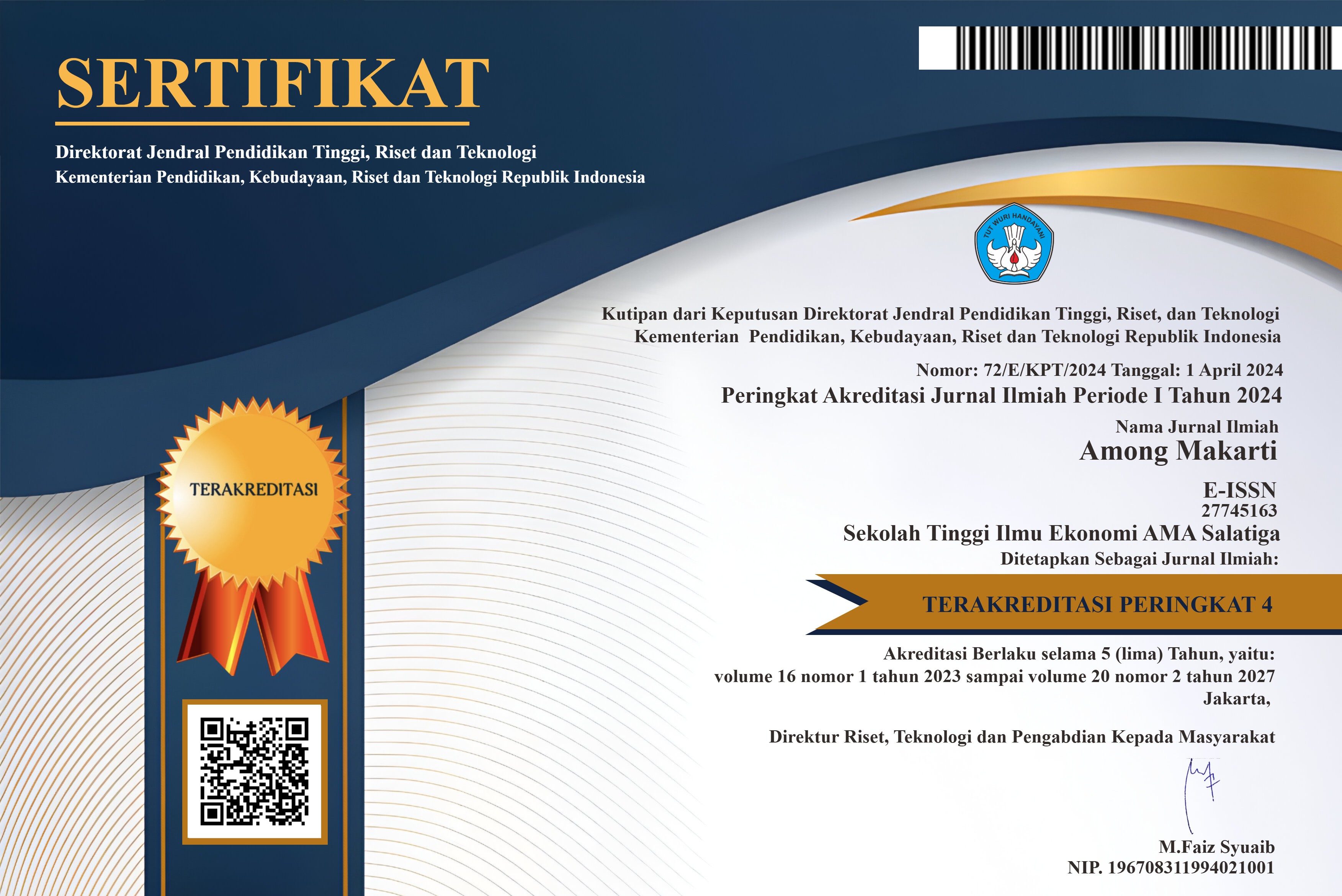
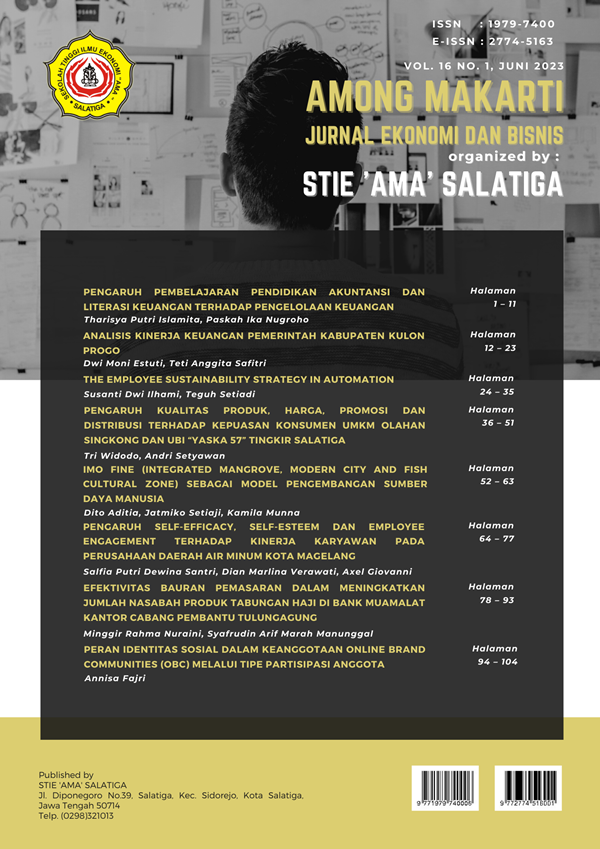
THE EMPLOYEE SUSTAINABILITY STRATEGY IN AUTOMATION
DOI:
https://doi.org/10.52353/ama.v16i1.406Kata Kunci:
Otomatisasi, Tinjauan Literatur Sistematis, Strategi Keberlanjutan KaryawanAbstrak
Along with the development of existing technology, automation continues to advance rapidly. The implementation of automation implemented by many organizations encourages the emergence of problems, especially among employees. Employee sustainability policies must be considered by the organization. Thus, an in-depth understanding related to employee sustainability is necessary. In this paper, we seek to identify the contribution of employee sustainability for facing automation through as systematic literature review (SLR). Particularly, we systematically: i) the definitions of automation clearly provided, ii) the affect of automation to an organization that implemented automation, iii) the strategy for facing automation by using employee sustainability. The effects of automation could substitute for labor and task not a job. This automation that is implemented by the organization also could create a new job so that it needs a new skill, but the negative affect, it could reduce well-being too. There are two strategies for employee sustainability namely training and work adjustment (adjustments to the organizational environment, work adjustments, adjustments to work superiors, and adjustments to colleagues where employees work). Further, based on our finding for this systematic literature review SLR, we should involve various disciplines such as mechanical engineering, psychology, and human resource management so that the discussion given is more in-depth and comprehensive involving various fields of science.Referensi
Acemoglu, D., & Restrepo, P. (2019). Automation and new tasks: How technology displaces and reinstates labor. Journal of Economic Perspectives, 33(2), 3–30.
Atkinson, R. D., & Wu, J. J. (2017). False Alarmism: Technological Disruption and the U.S. Labor Market, SSRN Electronic Journal, 185002015.
Autor, D. H., Dorn, D., Autor, B. D. H., & Dorn, D. (2016). American Economic Association The Growth of Low-Skill Service Jobs and the Polarization of the US Labor Market. American Economic Association Stable, 103(5), 1553–1597.
Badet, J. (2021). AI, Automation and New Jobs. Open Journal of Business and Management, 09(05), 2452–2463.
Black, J. S. (1975). Thr other half of the picture: antecedents of spouse crosss-cultural adjustment. Journal of International Business Studies., 3(2), 128–128.
Black, J. S., & Gregersen, H. B. (1991). Antecedents to Cross-Cultural Adjustment for Expatriates in Pacific Rim Assignments. Human Relations, 44(5), 497–515.
Bretz, R. D., & Judge, T. A. (1994). Person-organization fit and the theory of work adjustment: Implications for satisfaction, tenure, and career success. Journal of Vocational Behavior, 44(1), 32–54.
Calabrese, G. (1995). The employment effects of flexible integrated automation in small and medium firms: Evidence from the Italian case. Integrated Manufacturing Systems, 6(2), 35–41.
Chiaburu, D. S. (2010). The social context of training: Coworker, supervisor, or organizational support? Industrial and Commercial Training, 42(1), 53–56.
Chicu, S. O., Ţicău, A., & Şoitu, L. (2014). Training for New Technologies. Handwriting with New Technologies. Procedia - Social and Behavioral Sciences, 142, 781–785.
Chirgwin, P. (2021). Skills development and training of future workers in mining automation control rooms. Computers in Human Behavior Reports, 4, 100115.
Colbert, A., Yee, N., & George, G. (2016). The digital workforce and the workplace of the future. Academy of Management Journal, 59(3), 731–739.
Colombo, E., Mercorio, F., & Mezzanzanica, M. (2019). AI meets labor market: Exploring the link between automation and skills. Information Economics and Policy, 47, 27–37.
Coupe, T. (2019). Automation, job characteristics and job insecurity. International Journal of Manpower, 40(7), 1288–1304.
De Bruyne, E., & Gerritse, D. (2018). Exploring the future workplace: results of the futures forum study. Journal of Corporate Real Estate, 20(3), 196–213.
Docherty, P., Kira, M., & Shani, A. B. R. (2008). Creating sustainable work systems: Developing social sustainability. Stress Medicine.
Domini, G., Grazzi, M., Moschella, D., & Treibich, T. (2022). For whom the bell tolls: The firm-level effects of automation on wage and gender inequality. Research Policy, 51(7).
Eickemeyer, S. C., Busch, J., Liu, C. Te, & Lippke, S. (2021). Acting instead of reacting—ensuring employee retention during successful introduction of i4.0. Applied System Innovation, 4(4), 1–
Frey, C., & Rahbari, E. (2016). Do labor-saving technologies spell the death of jobs in the developing world? Prepared for the 2016. Brookings Blum Rountable.
Frey, P. (2021). Visions of automation: A comparative discussion of two approaches. Societies, 11(2).
Goos, M., & Manning, A. (2007). Lousy and Lovely Jobs. The Review of Economics and Statistics, 89(1), 118–133.
Gordon, S., Adler, H., Day, J., & Sydnor, S. (2019). Perceived supervisor support: A study of select-service hotel employees. Journal of Hospitality and Tourism Management, 38, 82–90.
Graetz, G., & Michaels, G. (2015). Robots at Work. CEP Discussion Paper, 1335, 1–53.
Henry, R., Crowley, F., & Doran, J. (2022). Regional variations in automation job risk and labour market thickness to agricultural employment. Journal of Rural Studies, 91, 10–23.
Hoyt, J., & Matuszek, T. (2001). Testing the contribution of multi-skilled employees to the financial performance of high-tech organizations. Journal of High Technology Management Research, 12(2), 167–181.
Huo, M. L., & Jiang, Z. (2021). Trait conscientiousness, thriving at work, career satisfaction and job satisfaction: Can supervisor support make a difference? Personality and Individual Differences, 183, 111116.
Ilhami, S. D., Armanu, & Noermijati. (2020). Research in Business & Social Science The impact of individual characteristics towards employee performance of millennial employees : The moderating effect of training. International Journal of Research in Business and Social Science, 9(4), 323–329.
Kitchenham, B., Pretorius, R., Budgen, D., Brereton, O. P., Turner, M., Niazi, M., & Linkman, S. (2010). Systematic literature reviews in software engineering-A tertiary study. Information and Software Technology, 52(8), 792–805.
Kiwanuka, F. N., Karadsheh, L., Alqatawna, J., Hudaya, A., & Amin, M. (2021). Modeling employee flexible work scheduling as a classification problem. Procedia Computer Science, 192, 3281–3290.
Koster, S., & Brunori, C. (2021). What to do when the robots come? Non-formal education in jobs affected by automation. International Journal of Manpower, 42(8), 1397–1419.
Kozak, M., Kozak, S., Kozakova, A., & Martinak, D. (2020). Is Fear of Robots Stealing Jobs Haunting European Workers? A Multilevel Study of Automation Insecurity in the EU. IFAC-PapersOnLine, 53(2), 17493–17498.
Lammi, I. J. (2021). Automating to control: The unexpected consequences of modern automated work delivery in practice. Organization, 28(1), 115–131.
Loi, R., Ao, O. K. Y., & Xu, A. J. (2014). Perceived organizational support and coworker support as antecedents of foreign workers’ voice and psychological stress. International Journal of Hospitality Management, 36, 23–30.
Mead, S., Sw, M., Hilton, D. W., In, H., Cord, C. O. N., & Curtis, L. (2001). Peer support A theoretical. Psychiatric Rehabilitation Journal, 25(2), 134–141.
Moreira, F., & Rocha, Á. (2017). A special issue on new technologies and the future of education and training. Telematics and Informatics.
Morrison, T., DeRocco, E. S., Maciejewski, B., McNelly, J., Giffi, C., & Carrick, G. (2011). Boiling point ? The skills gap in US. manufacturing. Deloitte Manufacturing, 16
Muro, M., Maxim, R., & Whiton, J. (2019). Automation and artificial intelligence: how machines are affecting people and places. Brookings India.
Na-Nan, K. (2019). Employee work adjustment scale for small and medium-sized enterprises in Thailand. International Journal of Quality and Reliability Management, 36(8), 1284–1300.
Na-Nan, K., & Pukkeeree, P. (2013). Influence of Job Characteristics and Job Satisfaction Effect Work Adjustment for Entering Labor Market of New Graduates in Thailand. International Journal of Business and Social Science, 4(2), 95–103.
Nazareno, L., & Schiff, D. S. (2021). The impact of automation and artificial intelligence on worker well-being. Technology in Society, 67(July), 101679.
Nazir, S., Kluge, A., & Manca, D. (2014). Automation in process industry: Cure or curse? How can training improve operator’s performance. In Computer Aided Chemical Engineering, 33.
Nicholson, N. (1984). A Theory of Work Role Transitions. Administrative Science Quarterly, 29(2), 172.
Nielsen, K., & Yarker, J. (2020). Job crafting as a work adjustment strategy for workers returning after long-Term sickness absence due to common mental disorders. International Journal of Rehabilitation Research, 43(2), 154–158.
Parschau, C., & Hauge, J. (2020). Is automation stealing manufacturing jobs? Evidence from South Africa’s apparel industry. Geoforum, 115(October 2019), 120–131.
Ruiz-Pérez, F., Lleo, A., & Ormazabal, M. (2021). Employee sustainable behaviors and their relationship with Corporate Sustainability: A Delphi study. Journal of Cleaner Production, 329.
Shimoni, T., Ronen, S., & Roziner, I. (2005). Predicting expatriate adjustment: Israel as a host country. International Journal of Cross Cultural Management, 5(3), 293–312.
Stähler, N. (2021). The Impact of Aging and Automation on the Macroeconomy and Inequality. Journal of Macroeconomics, 67(October 2020), 1–16.
Steinlechner, M., Schumacher, A., Fuchs, B., Reichsthaler, L., & Schlund, S. (2021). A maturity model to assess digital employee competencies in industrial enterprises. Procedia CIRP, 104, 1185–1190.
Susman, G. I. (1970). The Concept of Status Congruence as a Basis to Predict Task Allocations in Autonomous Work Groups. Administrative Science Quarterly, 15(2), 164.
Terry, D. J., Callan, V. J., & Sartori, G. (1996). Employee adjustment to an organizational merger: Stress, coping and intergroup differences. Stress Medicine, 12(2), 105–122.
van Dam, K., van Vuuren, T., & Kemps, S. (2017). Sustainable employment: the importance of intrinsically valuable work and an age-supportive climate. International Journal of Human Resource Management, 28(17), 2449–2472.
Williams, P. (2019). Support for supervisors: HR enabling flexible work. Employee Relations, 41(5), 914–930.
You, S. (2011). Peer influence and adolescents’ school engagement. Procedia - Social and Behavioral Sciences, 29, 829–835.
Zammuto, R. F., Griffith, T. L., Majchrzak, A., Dougherty, D. J., & Faraj, S. (2007). Information technology and the changing fabric of organization. Organization Science, 18(5), 749–762.
Unduhan
Diterbitkan
Terbitan
Bagian
Lisensi
Pernyataan Hak Cipta
Kesepakatan tentang Lisensi dan Hak Cipta
Dalam mengirimkan naskah ke Jurnal Among Makarti, penulis menyatakan bahwa:
Mereka telah diberi wewenang oleh rekan penulisnya untuk mengambil bagian dalam pengaturan ini.
Karya yang dideskripsikan sebelumnya belum pernah dipublikasikan secara resmi, kecuali dalam bentuk abstrak atau sebagai bagian kuliah, resensi, tesis, atau jurnal overlay yang diterbitkan.
Bahwa karya tidak sedang dipertimbangkan untuk dipublikasikan di tempat lain,
Bahwa publikasinya telah disetujui oleh semua penulis dan oleh otoritas yang berwenang – secara implisit atau eksplisit – yakni dari lembaga tempat karya tersebut dikerjakan.
Mereka menjamin adanya hak untuk mereproduksi materi yang telah diterbitkan atau dilindungi hak cipta di tempat lain.
Mereka menyetujui lisensi dan perjanjian hak cipta ini.
Hak Cipta
Penulis yang menerbitkan tulisannya di Jurnal Among Makarti menyetujui ketentuan berikut:
- Penulis memegang hak cipta dan memberikan hak publikasi pertama kepada jurnal dengan karya yang secara bersamaan dilisensikan di bawah

Creative Commons Attribution-ShareAlike 4.0 International License sehingga orang lain bisa berbagi karya dengan pengakuan kepenulisan karya itu dan publikasi awal ada pada jurnal ini. - Pemberi lisensi mengizinkan orang lain untuk membuat dan mendistribusikan karya turunan, tetapi hanya di bawah lisensi yang sama atau kompatibel.
- Pemberi lisensi mengizinkan orang lain untuk menyalin, mendistribusikan, menampilkan, dan melakukan pekerjaan, termasuk untuk tujuan komersial.
- Sebelum dan selama proses pengiriman, penulis diizinkan dan dianjurkan untuk memposting karyanya secara online (misalnya, di repositori kelembagaan atau di situs web mereka). Postingan semacam itu akan dapat menghasilkan pertukaran yang produktif, serta kutipan lebih awal dan lebih besar.
Perizinan untuk Publikasi Data
Jurnal Among Makarti menggunakan berbagai waiver (pengabaian) dan lisensi, yang secara khusus dirancang untuk dan sesuai untuk pengolahan data:
Lisensi Atribusi Open Data Commons, http://www.opendatacommons.org/licenses/by/1.0/ (default)
Creative Commons CC-Zero Waiver, http://creativecommons.org/publicdomain/zero/1.0/
Dedikasi dan Lisensi Domain Publik Open Data Commons, http://www.opendatacommons.org/licenses/pddl/1-0/
Lisensi penerbitan data lainnya dapat diizinkan sebagai pengecualian (tergantung persetujuan editor berdasarkan kasus per kasus) dan harus ditegaskan dengan pernyataan tertulis dari penulis yang akan dipublikasikan bersama artikel.
Data Terbuka dan Penerbitan serta Berbagi Perangkat Lunak
Jurnal ini berupaya untuk memaksimalkan replikabilitas penelitian yang dipublikasikan. Oleh karena itu, penulis diharuskan untuk membagikan semua data, kode, atau protokol yang mendasari penelitian yang dilaporkan dalam artikelnya. Pengecualian diperkenankan tetapi harus ditegaskan dalam pernyataan publik tertulis yang menyertai artikel tersebut.
Kumpulan data dan perangkat lunak harus disimpan dan diarsipkan secara permanen di repositori yang sesuai, tepercaya, umum, atau domain khusus (silakan lihat http://service.re3data.org dan/atau repositori perangkat lunak seperti GitHub, GitLab, Bioinformatics.org, atau sejenisnya).
Pengidentifikasi tetap terkait (misalnya DOI, atau lainnya) dari kumpulan data harus disertakan dalam data atau bagian sumber perangkat lunak artikel. Referensi kumpulan data dan perangkat lunak juga harus dimasukkan dalam daftar referensi artikel dengan DOI (jika tersedia). Jika tidak ada repositori data khusus domain, penulis harus menyimpan data mereka di repositori umum seperti ZENODO, Dryad, Dataverse, atau yang lainnya.
Data kecil juga dapat diterbitkan sebagai file data atau paket tambahan pada artikel penelitian, namun, penulis harus selalu lebih memilih deposisi dalam repositori data.